Tuesday, April 06, 2010

Gospel Doctrine Lesson #14 - Ye shall be a Peculiar Treasure unto me

Lesson #14 - Ye shall be a Peculiar Treasure unto me.
Exodus 15-20, 32-34


Background: From Abraham down to Jacob and his sons, the covenants and promises made by Jehovah to them were in their formative stages. During the patriarchal era, being a "father of many nations" meant being a family man with hopes of nations to be fulfilled in the distant future. According to Exodus, in Moses' day, Israel had grown to 600,000 people! The once small family was now the twelve tribes of the nation of Israel.

With the Exodus, Jehovah demonstrated he was more powerful than all the gods of Egypt. Even Pharaoh, who was considered god incarnate, sees his divine power and authority destroyed with his army in the Red Sea.

With their enemies behind them, Israel was ready to stand in the presence of the Lord.

Sing Ye To The Lord
Exodus 15


Many Bible scholars believe that the 5 books of Moses as we currently have them, were composed centuries after Moses,compiled from several main sources, which may have retained some of the oldest teachings through oral traditions passed down as
songs or hymns. History shared as songs ensured the history stayed very accurate from generation to generation.

Here we find two hymns are prepared, one by Moses and another by his sister Miriam. They were written and sung to ensure the defeat of the Egyptians by Jehovah at the Red Sea would not be forgotten. Many scholars believe that the hymns of Moses and Miriam are their original words passed down and recorded verbatim centuries later. Hymns are a musical mnemonic, a key to remembering and understanding ancient history.

Why do we sing hymns today? They remind us of holy and good truths that are important to remember. A child can long remember the words to "I am a child of God" or "Follow the prophet" easier than memorizing and remembering scripture.

Note that the term "Lord" is a place holder for the name "Jehovah." His name was considered too sacred to speak or even write down, except in holy places (Sinai, Tabernacle, Temple).

Think about what it means to proclaim: "The Lord is my strength and song." Israel has escaped slavery and has just seen their armed captors drowned in the sea. Ancient peoples sang hymns to worship and remember. Not only would they sing to Jehovah, the Lord was THE Song.

Israel forsakes all other gods: "he is my God." Moses' hymn foresees the building of a habitation, a tabernacle, a temple, a house of the Lord.
"My father's God" reminds us that this is the God of Abraham, Isaac and Jacob. Israel dwelt 400 years in Egypt, surrounded by their pantheon of gods, majestic temples, and personal house idols of these gods. With a plan to return to the promised land came a return to the worship of Jehovah.

Moses' hymn also ties these events to the Creation, as noted last week by David Larsen. There is a literal God of our fathers, who destroys his enemy. The waters represent chaos being brought into order (Exodus 15:8-10). As with the war in heaven (Abr 3, Moses 4, Rev 12:7-9), the Lord vanquishes his enemies and chaos. The people of God are "redeemed" and brought back to his presence in his "holy habitation," in "the Sanctuary" of God's mountain (Ex 15:13, 17).

Waters of Marah

Arriving atthe Marah oasis, Israel found the waters were "bitter." Waters became bitter for several reasons. Salt or other minerals could leech into the waters, rotting carcases could contaminate the water, or someone could have poisoned the waters. The Lord showed Moses a tree that could sweeten the waters, making them safe to drink. Allowing Israel to be a somewhat self-reliant, while still keeping them dependent on God, Jehovah would teach them desert survival by teaching them how to use the local plants.

With this assistance came the first part of the promise to Abraham, Isaac and Jacob. If Israel would be obedient, Jehovah would prosper them in the land, protecting them from plagues, famine and disease,

Flesh Pots of Egypt/Bread of Life
Exodus 16


Desert life is difficult at best, deadly at worst. A small group can manage a flock of animals and perhaps a little agriculture by an oasis.

However, 600,000 people cannot survive wandering in the wilderness together, especially not slaves who are accustomed to city life and the flesh pots of Egypt.

Therefore, Jehovah provides what they cannot provide for themselves. God could have just made their stomachs continuously full, or had baked loaves of bread waiting on their plates each day, but he didn't. Instead, he provided quail and manna, but Israel still had to gather and prepare the food. This ties in nicely with the LDS Church’s welfare program, where we are expected to be as self-sufficient as possible, but given liberally when we cannot help ourselves.

We find, though, that with the manna comes a specific guideline. Gather up just enough for that day’s meals, and twice as much the day before the Sabbath to cover two days. Even with such command from God, greed set in and many attempted to store more than a day’s worth. Once they found the manna would spoil and be filled with maggots, they obeyed. Again, some doubted that the manna would last two days and went out on the Sabbath to collect, only to find it was not there. Why is it that we just have to test the limits? God commands and we look for the loopholes, rather than just obey. Of course, for each of us, we have our own particular commandment(s) that we seek to find a way around.

The manna represents the Bread of Life, Jesus Christ (John 6:35). Christ, our daily bread, is life sustaining, and the only real spiritual food available in the entire desert of life. The manna is freely given, but each person must prepare and use it properly, otherwise it is of no good use. If we attempt to obtain salvation on the cheap by looking for loopholes, the atoning sacrifice of Christ will be as the rotting maggot-infested manna. When eaten/accepted with “prudence and thanksgiving” (D&C 89:11).

While today it does not seem as obvious how God brings forth physical food for us, we read:

“Yea, all things which come of the earth, in the season thereof, are made for the benefit and the use of man, both to please the eye and to gladden the heart;
“Yea, for food and for raiment, for taste and for smell, to strengthen the body and to enliven the soul.
“And it pleaseth God that he hath given all these things unto man; for unto this end were they made to be used, with judgment, not to excess, neither by extortion.
“And in nothing doth man offend God, or against none is his wrath kindled, save those who confess not his hand in all things, and obey not his commandments” (D&C 59:18-21).

Our bread of life, whether physical or spiritual, must not used in excess, and God’s hand recognized in all of it.


The First Battle
Exodus 17


The Amalekite nation worries about Israel’s approaching, and meets them on the battlefield. Moses has Joshua organize their forces, men who were trained as slaves, not warriors, to go out to battle with Amalek. Moses sat up on a hill observing the battle, representing Jehovah looking down on the affairs of mankind. Along side of Moses stood his two counselors, Aaron and Hur. As Moses raised his hands, the Israelites conquered, but as the day dragged on, his arms wearied and lowered, allowing Amalek to gain the upper hand. We see a battle not just of nations, but of the strength of their gods. I can imagine the king of the Amalekites sitting on a distant hill raising his hands and chanting incantations to his god to contradict the power of Moses’ God, Jehovah.

Aaron and Hur grasp Moses’ arms and hold them steady so that the victory goes to Israel. In this event, Moses represents Jesus/Jehovah. His arms are spread out like Jesus’ arms on the cross. During his atoning sacrifice, Jesus grew weary. In Gethsemane, he prayed that God would take away his cup. Later on the cross, Jesus would ask God, “Why hast thou forsaken me?” Yet in his weariness, he overcame the enemy for all of us. Israel conquers because their God is Jehovah, even Jesus the Christ.

Jethro the high priest
Exodus 18


Israel’s fame quickly spreads abroad, and Jethro/Reul the Midianite, hears about his son-in-law’s triumph against Egypt. Jethro comes to him, bringing Moses’ wife and children. In hearing about their successes and miracles, Jethro truly is amazed at Jehovah’s great power over Egypt’s gods and proclaims:

“And Jethro said, Blessed be the Lord, who hath delivered you out of the hand of the Egyptians, and out of the hand of Pharaoh, who hath delivered the people from under the hand of the Egyptians.
“Now I know that the Lord is greater than all gods: for in the thing wherein they dealt proudly he was above them.
“And Jethro, Moses’ father in law, took a burnt offering and sacrifices for God: and Aaron came, and all the elders of Israel, to eat bread with Moses’ father in law before God (Ex 18:10-12).

Jethro becomes a counselor to Moses as he sojourns in the area. Watching Moses spend countless hours judging menial problems, Jethro advises him to stop before he kills himself. Jethro tells Moses to select judges to rule over the people in their daily issues. Only the big matters should ever come to Moses.

The beginning of the Judges of Israel starts here. These are to be “rulers” over various numbers of people: thousands, hundreds, fifties and tens. If a decision could not be made on a certain level, it was sent up to the next level. This allowed decisions to be made at the lowest level possible, avoiding the huge top-heavy bureaucracies many ancient and modern governments struggle with. One size does not always fit all when it comes to human affairs. Should all killers be sentenced to death? How about killing in self defense? We shall see that God gives general guidelines through his head prophets and rulers, and allows for a wider level of interpretation and consideration the closer one gets to the lowest level of judges.

A Peculiar Treasure
Exodus 19

Arriving at Sinai, the Lord calls Moses forth to counsel him. As they speak, Israel can hear and see the tumult that the Lord’s glory casts upon the mountain. Jehovah tells Moses, “if ye will obey my voice indeed, and keep my covenant, then ye shall be a peculiar treasure unto me above all people: for all the earth is mine: And ye shall be unto me a kingdom of priests, and an holy nation” (Ex 18:5-6).

If they will accept Jehovah as their one and only God, they will become a special people in all the earth. They would not be like others who worshiped Jehovah as just another tribal god, but be placed above all others on earth. Jehovah was El Elyon’s chief son and given the prized possession of Israel as His inheritance. After centuries of preparation, Jehovah is now ready to accept Israel as his people, a “kingdom of priests and an holy nation.”

The people agree and pledge, “All that the Lord hath spoken we will do.” They are commanded to wash their clothes, cleanse themselves, be abstinent, and prepare to see God on the third day. On that day, the Lord’s glory caused thunder and lightning to explode around them. The angel of the Lord blew loudly on his trumpet for all Israel to hear, and it caused them to tremble. God descends to the mount, and calls forth Moses to speak with him, warning him to not allow any others except Aaron to ascend Mount Sinai at that time; otherwise they would not be able to withstand his glory. And it may even be more than that. Jehovah tells Moses, “Away, get thee down, and thou shalt come up, thou, and Aaron with thee: but let not the priests and the people break through to come up unto the Lord, lest he break forth upon them” (vs 24). Who is it that would “break forth upon” Israel? It seems that the angel of God waited on the mount as a sentinel to destroy any who were not worthy to stand in God’s presence.

The Ten Commandments
Exodus 20


Any Christian who has grown up since the early 1960s can describe Moses as looking like Charlton Heston, and that Jehovah speaks with a deep and long drawn out voice. Many can recite the Ten Commandments because they have watched the movie by that name annually during the Passover/Easter season for the last 50 years (it came out in 1956).

These were not the earliest set of written laws or commandments given to men. Hammurabi lived several centuries before Moses and put forth a set of laws that are often complimentary to the Ten Commandments.

The Ten Commandments were given to the nation. Israel is a “holy nation” and a “kingdom of priests”, not just individuals. These commandments were given to ensure the nation as a whole remained pure and holy, so that they could retain the blessings of God and be a city on the hill for other nations to see and contemplate.

The 10 Commandments are divided up into two main sections: how we are to deal with God, and how we are to deal with mankind. The first four deal with God, with six commandments dealing with our fellow beings.

Many people think the first two commandments are directly related, but they are not. One discusses actual gods, while the second discusses false/fake idols.

1. “Thou shalt have no other gods before me” means that there were other gods, real gods. However, Jehovah would be the premier and chief God, the only one Israel was to worship. We will see this later in the lessons as we find that Israel recognized other gods and goddesses, such as Asherah, who was Jehovah’s consort/wife, but were not to worship them. Ancient Israel believed in monolatry, the worship of one god, while believing there are other real gods as well.

2. As mentioned, the second commandment refers directly towards graven images or idols. We are not to make nor worship the image of anything, whether it be a god or anything else. This is especially true in our day, when humans in the modern world tend to be extremely materialistic and humanist. Yes, we believe in God, but not enough to eschew our sins and vices.

3. Taking the Lord’s name in vain means more than just using his name as a swear word. It means anything that could be considered sacrilegious or blasphemous. God is raising up a kingdom of priests, a holy nation, and therefore they must stand head and shoulders above the peoples of other nations. Since God is holy, and they are God’s children, they too are holy and must act accordingly in all things.

4. Keeping the Sabbath day holy becomes one of the major commandments for Israel. Under the Mosaic Law, not only is a person stoned to death for murder, but he is also stoned to death for breaking the law of the Sabbath Day! One is equally as important as the other. Why? Because the Sabbath day becomes the symbolic day when we lay aside the worldly things and enter into God’s holy sphere. It becomes a day of spiritual rest, when we enter into the Lord’s rest/presence by anointing all things in our lives and setting it apart for one day to holy worship. Separation from God equals spiritual death, and the person who breaks the Sabbath is separating him/herself spiritually from God. In Israel, the person has contaminated the purity and sanctity of the nation, and the contamination must be removed if the nation is to survive.

5. Honor thy father and thy mother. This commandment comes with a promise of long life. Under the Mosaic Law, a rebellious child could be taken before the elders of Israel and condemned. Such children would be stoned to death, in order to keep the nation pure and holy. We will see that rebellion against parents and the Lord’s anointed prophet will be among Israel’s biggest challenges. It also represented a long spiritual life when a person honored their parents, as the earthly representatives of their heavenly parents.

6. Thou shalt not kill. Under the Law given to Noah, this included the killing of man and the unnecessary killing of animals. Life was to be considered sacred. Only God could take life, and man could only do so under God’s command.

7. Thou shalt not commit adultery. The history Abraham’s family contains a long line of men with unrighteous sexual desires. Ishmael and Esau married outside of the covenant family. Reuben slept with his stepmother. Judah slept with his daughter-in-law. Levi and Simeon massacre the city of Shechem because a young man slept with their sister. Only a few, such as Jacob and Joseph are shown to be chaste and righteous in this history. For God, fidelity is necessary. If a man could not be faithful to his wife, how could he ever be faithful to God?

8. Thou shalt not steal, is a very simple command that covered any and all forms of theft.

9. Bearing false witness against one’s neighbor opened the door for a nation’s destruction. If lies spread about, then who can be trusted? During the French Revolution’s Reign of Terror, anyone who had a problem with his neighbor could falsely claim against that individual and have him found guilty in a kangaroo court. Lies, gossip, and false innuendo can bring chaos. And if a person will lie about their neighbors, they will lie to their God, as well.

10. Thou shalt not covet anything. This is an amazing commandment at this time and period of history. To command that people not be greedy advanced Israel’s society. It ensured that the nation worked as a group, and not be threatened with breaking up into small groups or individuals who would seek to get gain at the expense of the nation.

The People Reject God’s Presence

Moses returns to give the commandments to the people, and to bring them up the mount with him. However, the people “saw the thunderings, and the lightnings, and the noise of the trumpet, and the mountain smoking: and when the people saw it, they removed, and stood afar off. And they said unto Moses, Speak thou with us, and we will hear: but let not God speak with us, lest we die. And Moses said unto the people, Fear not: for God is come to prove you, and that his fear may be before your faces, that ye sin not. And the people stood afar off, and Moses drew near unto the thick darkness where God was” (Ex 20:18-20).
In other words, the people told Moses they were not interested in entering into God’s presence. They were happy to listen to the prophet, but were too frightened of God and his power.

In modern revelation, we come to understand this event better:
19 And this greater priesthood administereth the gospel and holdeth the key of the mysteries of the kingdom, even the key of the knowledge of God.
20 Therefore, in the ordinances thereof, the power of godliness is manifest.
21 And without the ordinances thereof, and the authority of the priesthood, the power of godliness is not manifest unto men in the flesh;
22 For without this no man can see the face of God, even the Father, and live.
23 Now this Moses plainly taught to the children of Israel in the wilderness, and sought diligently to sanctify his people that they might behold the face of God;
24 But they hardened their hearts and could not endure his presence; therefore, the Lord in his wrath, for his anger was kindled against them, swore that they should not enter into his rest while in the wilderness, which rest is the fulness of his glory.
25 Therefore, he took Moses out of their midst, and the Holy Priesthood also;
26 And the lesser priesthood continued, which priesthood holdeth the key of the ministering of angels and the preparatory gospel;
27 Which gospel is the gospel of repentance and of baptism, and the remission of sins, and the law of carnal commandments, which the Lord in his wrath caused to continue with the house of Aaron among the children of Israel until John, whom God raised up, being filled with the Holy Ghost from his mother’s womb (D&C 84:19-27).

The Melchizedek Priesthood, which Moses held, contained the keys to the knowledge of God. This is the literal knowledge of God, to see His face and behold His glory. But Israel, when given the chance, as a body, rejected God’s offer. They were not ready for a Celestial experience. And so God gave them the lesser priesthood of Aaron with its carnal commandments (the Mosaic Law) and with a preparatory set of ordinances. This set of ordinances would not exalt them, but could prepare them for the day when they would be ready for the fullness of the gospel, the fullness of the priesthood, and to receive the fullness of God’s presence.

This is the goal of every prophet, to take his people into the presence of God. This event on Mt Sinai was equivalent to the LDS endowment, as we practice in our holy mount, the temple, to cleanse ourselves and enter into the Lord’s presence. Everything in the gospel points toward Israel as a nation, ancient and modern, entering into God’s presence.

The Mosaic Law

As just mentioned, the Mosaic Law was given as a preparatory law. The Israelites were not ready nor willing to live Christ’s higher law of love and obedience, and so were given a law of carnal commandments and ordinances. They were a major step above the expectations they had as slaves in Egypt, but still less than the greatest blessings God hoped to bestow upon them. These laws are enumerated in Exodus 21-31, including an “eye for an eye, tooth for a tooth” which may seem awful today, but was much better than the previous practice of if you take my eye, I’ll kill your entire family.

Later, some of the elders of Israel DID prepare themselves to see God. In Exodus 24, we read,
“Then went up Moses, and Aaron, Nadab, and Abihu, and seventy of the elders of Israel: And they saw the God of Israel: and there was under his feet as it were a paved work of a sapphire stone, and as it were the body of heaven in his clearness. And upon the nobles of the children of Israel he laid not his hand: also they saw God, and did eat and drink” (Exodus 24:9-11).

What do we find out from this experience? First, Man CAN see God and live! The requirements are that they are clean and holy, and they are brought forth through the power and keys of the Melchizedek Priesthood to see God. Second, God is man-like. If the elders saw God’s feet, then we are describing anthropomorphic features of God.

The Tabernacle
Exodus 25-27


As Israel prepares to leave the holy mountain, God commands them to take a portable sacred space with them, the Tabernacle. Prior to this time, Jehovah’s “temples” were solitary places made holy by prophets anointing them, such as Jacob at Bethel. Israel was now a nation, and required God’s sanctuary to go with them. The Tabernacle was made of curtains and rods, making the various rooms and sections to perform various ordinances of the Aaronic Priesthood.

The innermost room was the Holy of Holies, where God’s presence dwelt. It was separated from the rest of the Tabernacle by a sacred veil. Inside the Holy of Holies would be the Ark of the Covenant. This was a golden box with the Mercy Seat of God on top. The seat was shrouded by the wings of two golden cherubim, warrior-angels of God. Unlike the Egyptian temples, there were no statues of God in the Tabernacle, as God’s likeness was not to be reproduced for worship. Instead, Israel was to worship the “invisible” God, who sat between the cherubim on the Mercy Seat.

In the room outside the Holy of Holies stood other sacred items: the table of shewbread and the candlestick or Menorah. Today, we see that the table of shewbread represents the Savior Jesus Christ, and his sacrifice. The bread represents both the Bread of Life manna that God gave to the people, and the Bread of Life Christ, who saves all mankind. We partake of the Sacrament/communion bread today in memory of Jesus’ sacrifice. The Menorah represents the light of the Holy Ghost. As we approach nearer to God, it lightens the way for us, preparing us to enter into God’s full presence.

So, the Tabernacle is representative of the Godhead members and our entrance into their presence as we prepare ourselves.

The Tabernacle/Temple Clothing
Exodus 28


The Levites, and specifically Aaron and his sons, were chosen to be the acting priests in this kingdom of priests. Their sole responsibility would be to manage the Tabernacle and the worship therein.

Holy garments are made for Aaron and his sons: “these are the garments which they shall make; a breastplate, and an ephod, and a robe, and a broidered coat, a mitre, and a girdle: and they shall make holy garments for Aaron thy brother, and his sons, that he may minister unto me in the priest’s office” (Ex 28:4). Let’s break this down.

Breastplate was an ornamental metal piece worn over the breast. Wikipedia explains:
“A breastplate is a device worn over the torso either to protect the torso from injury, or as an item of religious significance, or as an item of status. A breastplate was sometimes worn by mythological beings as a distinctive item of clothing.”

In this instance, the breastplate on Aaron’s garment held 12 stones which represented the Tribes of Israel, and together made the Urim and Thummim. Aaron and his sons would have to be in the temple and wearing their holy garment in order to receive revelation via the Urim and Thummim.
“And thou shalt put in the breastplate of judgment the Urim and the Thummim; and they shall be upon Aaron’s heart, when he goeth in before the Lord: and Aaron shall bear the judgment of the children of Israel upon his heart before the Lord continually” (Ex 28:30).

The ephod was a linen apron. While most would imagine that all of the priest’s clothing would be white, the ephod or apron was not: “ephod of gold, of blue, and of purple, of scarlet, and fine twined linen, with cunning work” (Ex 28:6). The girdle was a long rope of linen that wrapped around the waste to hold the ephod and robe in place. Linen breeches were made as an under garment, “thou shalt make them linen breeches to cover their nakedness; from the loins even unto the thighs they shall reach” (Ex 28:42).

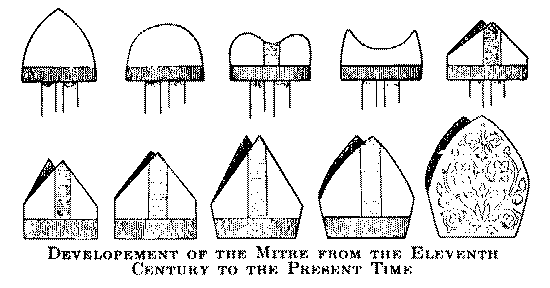
The main outfit included the robe and a embroidered outer coat. The mitre was a hat or bonnet that represented a crown, and had Jehovah’s name written in it. Over the years, the mitre used in the Catholic Church has evolved into the one worn by the Pope today.


http://upload.wikimedia.org/wikipedia/commons/1/17/Mitre_evolution.gif


Aaron’s robes did not just represent all of Israel, but according to the Wisdom of Solomon "upon Aaron's garment was the whole universe" (Wis.18:24).

The historian, Philo taught,
"Now such was the raiment of the high priest; and both it and its parts have a meaning which must not be passed over in silence. For the whole is in fact a representation and copy of the cosmos, and the parts are representations of its several portions" (Philo, Life of Moses II.117).

Josephus explained that
"the tunic of the high priest signifies the earth since it is made of linen, and the blue color signifies the vault of heaven… And I believe that the ephod represents the nature of the universe which God thought good to make of four components; it was woven with gold signifying sunlight which beams upon all things. And he arranged the breastplate in the midst of the ephod after the manner of the earth, for it also has the most central place. And he surrounded it with a girdle, thereby signifying the ocean, for this too comprehends everything (Josephus, Jewish Antiquities, III.184). http://www.orthodoxresearchinstitute.org/articles/church_history/klitsenko_orthodoxy_england.htm


The Washing and Anointing of Aaron and his sons
Exodus 29


Aaron and his sons are washed in the large basin, built for washing/cleansing the physical body prior to entering into the Tabernacle. This was placed in the outer court, where all the people could cleanse themselves prior to entering the holy sanctuary.

Once washed, they were clothed with the garments of the Tabernacle, and then anointed with oil.

Once they were prepared, the first animal sacrifices were made. In specific order, the Prophet Moses and the priests of Aaron performed the following sacrifices: a Sin offering, a Burnt offering, a Consecration offering, a Heave offering, and a Peace offering.

The Stone Calf and the Garden of Eden
Exodus 32-33


Moses spent 40 days on Sinai receiving instruction from God. Upon receiving the stone tablets, Moses discovers that Israel has already broken all 10 of the Commandments he has already given them orally. The people feared Moses was dead. Had they not feared to go into God’s presence themselves? And now Moses was long delayed, over a month. The slaves reverted to what they knew: the gods of Egypt.

Among the gods they created was a molten calf. There were others, as they declare, “these by thy gods, O Israel, which brought thee up out of the land of Egypt” (Ex 32:4). The molten calf is singled out because it is more representative of the gods of the Canaanites, the people Israel will soon seek to throw out of the Promised Land. The Canaanites worshiped a pantheon of gods, including Baal and his father, El Elyon. Both Baal (which means “Lord”) and El Elyon were represented figuratively by the calf or bull. It represented strength and power, as well as fertility. Jehovah was also a divine son of El Elyon, but his kingdom was Israel. They were not to worship other gods. They were not to make idols of gold or silver.

Interestingly, upon making the idols, Aaron proclaims a festival. “To morrow is a feast to the Lord” (Ex 32:5). This is not a feast for the Egyptian gods that they claimed saved them from Egypt, but a feast to the Lord, with the golden calf as representative of Him! They were replacing the worship of Jehovah with the older worship of El, or perhaps the Canaanite worship of Baal, perhaps in hopes of having the head gods of the land of Canaan accept them and allow them into their Promised Land.

But Moses returns to see the rebellion. He grinds the calf to powder, tosses it into the drinking water and makes the people drink it. The Levite priests run through the population, killing people as they go. Jehovah is a jealous god, and will not tolerate rebellion. If they are to be a holy nation and kingdom of priests, they must be focused solely on Jehovah as God.

This story is symbolic of the story of Adam and Eve in Eden. God was with them for a while, and then left. While he was gone, they listened to the serpent and disobeyed God. When God returned, he had no choice but to chastise them, pronouncing spiritual death upon them. Moses is representative of Jehovah before the people. He is in many ways their god (with a little “g”). Jehovah even told Moses that Moses would be as god, and Aaron his prophet. But as with Adam, Aaron listened to the wrong voice, was deceived into thinking that God/Moses was delayed or would not come back, and tried a solution he was already warned not to do (don’t eat of the fruit/ do not make idols).

As God put the serpent and his followers in their place; Moses put the calf and its followers in their place as well. God sends a plague upon Israel, and moves his Tabernacle out from the middle of the congregation. They are spiritually dead and cast out, even as Adam was cast out of the Garden. Even Moses, who once spoke with God face to face, can now only hear his voice and see his back parts, but not see his face or glory.

Returning to God’s presence
Exodus 34


After a long period of repentance, God begins to forgive Israel for their rebellion. He commands Moses to hew a new set of stones to put the commandments on. These are different than the first. Moses makes this set, while God made the first with his own hands. Moses ascends the mount, where the Lord reappears to Moses, proclaims his holy name, and makes a new covenant with Israel. They are no longer cast out of His presence, but have been redeemed through their repentance and His forgiveness.

The Lord proclaims, “Behold, I make a covenant: before all thy people I will do marvels, such as have not been done in all the earth, nor in any nation: and all the people among which thou art shall see the work of the Lord: for it is a terrible thing that I will do with thee.
11 Observe thou that which I command thee this day: behold, I drive out before thee the Amorite, and the Canaanite, and the Hittite, and the Perizzite, and the Hivite, and the Jebusite.
12 Take heed to thyself, lest thou make a covenant with the inhabitants of the land whither thou goest, lest it be for a snare in the midst of thee:
13 But ye shall destroy their altars, break their images, and cut down their groves:
14 For thou shalt worship no other god: for the Lord, whose name is Jealous, is a jealous God:
15 Lest thou make a covenant with the inhabitants of the land, and they go a whoring after their gods, and do sacrifice unto their gods, and one call thee, and thou eat of his sacrifice;
16 And thou take of their daughters unto thy sons, and their daughters go a whoring after their gods, and make thy sons go a whoring after their gods.
17 Thou shalt make thee no molten gods (Ex 34:10-17).

The Lord restates the Ten Commandments and adds a few more requirements to prevent Israel from rebelling again. If Israel accepts the Canaanite culture, they will fall. They aren’t to accept that culture, intermarry, or allow their gods and idols to exist.

With the renewed covenant and return to God’s Presence, Israel is ready to meet their destiny in the Land of Promise.

Thursday, March 25, 2010

Gospel Doctrine Lesson #13, the Exodus

Gospel Doctrine Lesson #13, the Exodus
Exodus 1-11.


Background:
The people of Israel moved to the delta region of Egypt in order to escape a severe drought and famine. Joseph became the Pharaoh’s adopted son in being his Second in the land. Many scholars believe that the Pharaohs of this time were from the Hyksos. The Hyksos were a Semitic/Asiatic people that entered Egypt and later ruled it for over a century. They Hyksos were shepherd kings, something regular Egyptians would have despised or looked down upon. The main Hyksos kings from the 15th Dynasty had Canaanite names. They introduced the compound bow and horse-drawn chariot to Egypt, and moved the capitol to Thebes.

Wikipedia tells us: “The people are shown below wearing the cloaks of many colors associated with the mercenary Mitanni bowmen and cavalry (ha ibrw) of Northern Canaan, Aram, Kadesh, Sidon and Tyre.” Note the possible tie with Joseph’s coat of many colors. Hyksos - Wikipedia, the free encyclopedia

In the 18th dynasty, the Hyksos were pushed out of Egypt by Ahmose I. It is possible that at this time, the Pharaoh “knew not Joseph”, as the Semites from Canaan were now out of power. The remaining Semites in the land of Egypt would either have to be driven out or enslaved to keep them from regaining power. The children of Israel, along with many other Asiatics living in the Nile Delta region were enslaved by the Egyptians, to prevent them from joining with the Hyksos (the enemies of Exodus 1:10), thereby gaining the throne of Pharaoh again.


Merneptah Stele, Cairo Museum

The new Pharaohs would use the Israelite slaves to make bricks and build a new group of cities for the new Pharaoh. These were “treasure cities, Pithom and Raamses” (Ex 1:11). These two cities were built by the Pharaohs Seti I and Raamses II, who are considered by many to be the Pharaohs of Israel’s oppression. This would possibly make Raamses II or Merneptah the Pharaoh of the Exodus. A lot of it depends upon the interpretation of a writing where it mentions in the Year 5 Merneptah Stele (ca. 1208 BC) that "Israel is wasted, bare of seed." Was it propaganda to cover up this king's own loss of an army in the Red Sea? Or was it disdain for the Israelites, who would now be wanderers in the desert without a land of their own? Either way, it helps us to determine approximately when Israel left Egypt (Merneptah Stele - Wikipedia, the free encyclopedia ).


Merneptah Stele: “Israel is wasted, bare of seed.”


Amram, Father of Moses’ Vision

In the Testament of Amram (4Q Amram, Dead Sea Scrolls), we find that Moses’ father has a unique vision. In it, he sees two “Watchers” or divine beings who are arguing over Amram. He asks who they are and they tell him they “rule over sons of men” in all the world. Amram is given a challenge: “And they said to me: ‘Which of us do you [choose]?’”

He studies them and sees that one of them is “like a viper” ruling over darkness. The other being rules “over all light”. This one has three names, one of which is probably Melchizedek, the high priest of El/God in Abraham’s day (see previous lesson blog on Abraham for more on Melchizedek). We find again that sacred names are important, giving the individual power. We are then warned about the battle between the “Sons of Light” and the “Sons of Darkness”, a major theme in the Dead Sea Scrolls.

This sits well with the story of the Exodus, which is exactly that. We have the Sons of Light, the Israelites in mortal combat with the Sons of Darkness, the Egyptians and any other enemies they might have. As we consider the Bible story and other related materials, we’ll see how this fits in.

Books of Jubilees and Jasher on Israel’s stay in Egypt

We find out in the Book of Jubilees, chapter 46, that the “treasure cities” of Pithom and Raamses are cities of defense, to defend against warring Canaanites (such as the Hyksos). Upon enslaving the Israelites, the Egyptians slew the children for a period of seven months (ch 47).

The Book of Jasher tells us that Israel was very powerful. They were warriors that initially fought with the Egyptians to fend off attacks by the Asiatics (Chittim), which included Sea Peoples (Asiatics who were originally from the Greek isles) and the Canaanites. In one battle, the Egyptians fled from the Asiatics, leaving Israel to fight them alone. The Israelites succeeded in winning the war. Angry that their counterparts fled, they slew many of the Egyptian soldiers for cowardice, and returned to their homes. Egypt fears Israel’s power, as they are obviously much mightier in battle than they are.

In order to subdue the Israelites, Egypt turns to cunning methods to enslave them. They ask the Israelites to come build up the fortified cities of Pithom and Raamses as a protection in the area. They are offered workers’ wages for the effort. All the tribes go, except for the tribe of Levi, which remains behind to tend the flocks, etc. With cunning, they end up enslaving the Israelites and force them to build the cities of protection. (Jasher 64-66).

And so things are when Moses is born.

Moses’ birth and the Massacre of the Innocents

Moses’ birth comes at a very difficult period. The Pharaohs have enslaved the Israelites, but still see them propagating so quickly that they fear a future overthrow could occur. Pharaoh first calls upon the midwives of Israel to ensure the males are aborted. The midwives quietly refuse to do such wicked work, and tell Pharaoh that the Hebrew women give birth before they can even show up. Pharaoh goes to more drastic measures and openly calls for the death of all male Israelite babies in Egypt as a birth control method. In keeping their numbers down, the hope is to keep them under control for future dynasties.

In the Book of Jubilees, we find that the children are slain for seven months (Jub. 47:3). The Book of Jasher details exactly how it came about: Pharaoh has a nightmare. In it, he sees an old man waving a balance (scales for weighing) in front of Pharoah. He calls forth his wise men to interpret the disturbing dream. Baalim of Beor tells him that it means that Israel would weigh Pharaoh in the balance and find him wanting. Israel would destroy Egypt and then leave.

Fearing such a disaster, Pharaoh consults to see what should be done. Reul/Jethro of Midian tells him he should let the Israelites go, and save his land of Egypt. Pharaoh becomes angry at this suggestion, and Jethro quietly leaves back to his home land. Baalim suggests drowning all the newborn sons of the Israelites in order to stop them from overthrowing Egypt. Pharaoh tells the Israelites to slay their own children. The women choose instead to deliver their babies in the fields and leave them. Angels come to the babies, washing and anointing them. Each baby is given two stones to suck on: one containing milk and the other honey. When the Egyptians find the babies prospering in the fields, they begin throwing them into the Nile River to drown.

This period of killing foresees the massacre of the innocents in Bethlehem by King Herod more than 1000 years later, when he feared that he and his royal line would be overthrown by a king born in the city of David. Moses becomes a symbol for Jesus Christ. While Jesus fled with his parents to Egypt to escape King Herod’s tyranny, Moses escapes the dangers of his enemies by becoming a member of the royal family of Egypt! The Book of Jubilees states that after he is weaned and grown a little, Moses is taken into Pharaoh’s house and becomes his son (Jub 47:10-11). However, unlike Cecille B. DeMille’s movie Ten Commandments, Moses knows he is an Israelite by birth. His skin would be lighter, and he would have Asiatic/Semitic features, while the Pharaoh’s family would most certainly be of Egyptian descent.

Moses’ birth is foreseen by his older sister Miriam: “And it was at that time the spirit of God was upon Miriam the daughter of Amram the sister of Aaron, and she went forth and prophesied about the house, saying, Behold a son will be born unto us from my father and mother this time, and he will save Israel from the hands of Egypt” (Jasher 68:1).

While Pharaoh’s daughter called his name “Moses” (drawn out), “Jochebed his mother called his name Jekuthiel, Because, she said, I have hoped for him to the Almighty, and God restored him unto me” (Jasher 68:26).

In the Book of Jasher it tells us that at 3 years of age, while eating with the royal family, Moses takes the crown off Pharaoh’s head. All are astonished, and Baalim tells the king that this is the Hebrew child that would one day overthrow him, and that he must be killed instantly. An angel, disguised as one of Pharaoh’s counselors, suggests they place an onyx stone and a hot coal before the child. If the child takes the onyx stone, they would know he was aware of what he was doing in taking the crown from Pharaoh. The angel guides the boy to grab the coal, burns himself on his lips and mouth. This is why Moses would later tell God he had a speech defect and needed Aaron to speak for him (Jasher ch 70).

As he grew, he learned of Balaam’s actions against Israel and Moses, and sought to slay Balaam. Balaam found out and fled Egypt.

Moses goes to Midian

Before we discuss this, I would note that I was planning on discussing how the story of Moses and the Exodus is a Creation/Temple story. However, as I was preparing this lesson, my friend David Larsen beat me to the punch and gave an excellent explanation of it on his blog. I recommend you study it here:
The Exodus Narrative as Another Creation Story (for Old Testament Lesson 13) | Heavenly Ascents

Moses sees an Egyptian whipping a Hebrew slave. Some accounts state that the Hebrew was Moses’ best friend, while another states the man ran to Moses pleading for his/Pharaoh’s protection, as the Egyptian had stolen his property and wife, and was now going to kill him over them. Moses confronts the Egyptian and ends up slaying him. Hoping to hide the evidence, he buries the Egyptian in the sand, however he soon finds out that the murder is spreading everywhere.

God leads Moses from Egypt to the land of Midian. The land of Midian is believed to have been in northwest Arabian peninsula on the east shore of the Gulf of Aqaba. Some scholars, however, do not think they were so much geographical as they were a league of tribes. The Midianites worshiped a variety of gods, including Baal and Ashtoreth. It is possible they also worshiped the Egyptian goddess Hathor, as an Egyptian temple to her was also in the area. Midian - Wikipedia, the free encyclopedia

However, at least one Midianite worshiped the Lord. We learn in D&C 84:6-7 that Moses was ordained to the Melchizedek Priesthood by his father-in-law Jethro. He would also have learned about the gospel from Jethro, as well.

According to the Book of Jasher, Moses was a warrior, helping the people overtake other nations. Moses fled initially to Cush, where he soon became its leader, when the king died. For years he fought Arabs and many tribes as the king of Cush. However, he knew he could not marry a Canaanite woman, as was commanded by Abraham concerning his son Isaac. He refused to marry the queen, and so he reigned for twenty years. Eventually, the queen’s son became a man, and she asked the people to throw down Moses as a foreigner and replace him with her son, the rightful heir of Cush. They gave Moses great gifts and thanks for his service, and then sent him packing. So Moses eventually made his way to Midian. (Jasher 76).

The Sapphire Staff of Adam

However, the Midianites are concerned that Moses has fled from Cush, and thinking he may be a fugitive, they place him in prison. Zipporah cares for him while he serves ten years in prison. In the meantime, the Pharaoh contracted leprosy. He tries curing it by spreading the fresh blood of a sacrificed Israelite child on his skin, each day for more than a year. But it does no good. Eventually his rotted body dies, and his son takes his place as Pharaoh (Jasher 76). Moses’ wrongful imprisonment is symbolic of the imprisonment of Joseph, who would later save his people in Egypt; and Jesus who would after his false imprisonment save his people from spiritual Egypt.

Upon release from prison, Moses prays in the garden of Reul/Jethro. While praying, he sees a sapphire staff planted in the ground with the name of the Lord of Hosts upon it. He takes the staff, which stuns Reul. The staff had belonged to Adam in the Garden of Eden. It was passed down to Noah and then to Abraham, who passed it down the line to Joseph. It became a treasure of Egypt, and when Reul left Pharaoh, he took the staff with him and planted it in his garden. Many mighty men tried to pluck the staff from the ground but could not. When Moses succeeded, Reul gave him Zipporah as his wife (Jasher 77).

The Holy Mountain

Outside of major kingdoms, such as Egypt, were the nations large enough to build vast cities. The Midianites were likely a tribal shepherd people with a few small towns. They would not have had a place for a major religious building.

Holy places were created in the wilderness. Jacob saw God in a dream and set up a pillar, which he called Beth-El, the House of God. For Moses, it was a mountain on fire that attracted him to Jehovah’s sacred place in the wilderness. The temple is a holy mountain, a sacred space, where earth and heaven are connected. It is where people go to enter into the glory and presence of God. And it is here that Moses sees God and receives his commission as prophet.

Return to Egypt and the Plagues

The Book of Jubilees tell us that on Moses’ return to Egypt, the demon Mastema sought to destroy him, and save his children, the Egyptians.

Moses’ initial attempt to impress the Egyptians fails. While he can turn his hand leprous and heal it, and while he can turn his staff into a serpent, so can the Egyptian sorcerers through Mastema’s power (Jub 48). God wreaks vengeance upon the Egyptians through the plagues, however. The Egyptian magicians cannot duplicate them, nor stop them. It is a classic battle of who has the true authority. In the stories of Abraham, including the Book of Abraham, we see a clash of titans, each side insisting that their God can beat up the other person’s God. In the Book of Abraham, we see that Pharaoh claims to have the ancient authority, while Abraham insists HE is the one that God has chosen as the rightful servant and heir of Jehovah. This competition between gods will happen time and again through Israel’s history, but is punctuated in the story of Moses and Pharaoh.

Eventually Pharaoh is forced to allow Moses to leave with Israel. The land is so demoralized and left in such chaos that no one has the will to stop Israel from leaving. At least for a few days. Suddenly they realize they have lost their meal ticket, and the Egyptians rush out to get Israel back. Again, Jehovah thrashes the Egyptians, opening a road in the chaotic waters for Israel to arrive safely on the other side, and then allowing chaos to resume in drowning the Egyptian army.

Order from Chaos

Most gods of the time were national or tribal gods. They were limited to where and when they could work their power. Jehovah demonstrated in the past that he is stronger than the gods of Pharaoh, as he saved Abraham from the priest of Elkaneh and the gods of Egypt. Jehovah saved both Israel and Egypt in raising Joseph up in Egypt. Now Jehovah would show his might once again, by illustrating his destructive and creative forces over the land of Egypt. Why do I say that? Because the Destruction and Creation go together. David Larsen’s article goes into this somewhat. With the destruction of Egypt, Jehovah is able to create a new people of Israel. They leave the chaos and desolation of Egypt behind and go toward the ordered Land of Promise, where milk and honey flow.

The Passover – Exodus 11

The Passover was designed by Jehovah to be Israel’s first national festival. It celebrated the night when the Angel of Death passed over the homes of the Israelites and killed the first born children of Egypt. Once again, it is representative of Creation/Order out of Destruction/Chaos. With Pharaoh and Egypt’s continual refusal to let Israel leave, they had proven themselves ripened for destruction. They had slain the infant sons of Israel, enslaved thousands more, and had become an indolent, evil and proud people.

Now it was time for the Lord to redeem his people. There are several portions to the Passover that we’ll review.

Paschal lamb: The lamb was to be without blemish and the first born of the field that spring. They were to eat all of it, not leaving any to spoil. If a family was too small to eat it alone, they were to invite the neighbors in to eat it with them. It represents the future role of Jehovah as sacrificial lamb for Israel and the entire world. He would take the chaos of death and reorder it into a new creation, immortality and eternal life. Since there is more than enough of Christ’s atonement, we are also encouraged to invite our neighbors to partake of the atonement of Christ with us, that they too might be saved.

Blood on the door posts: The blood of the lamb was smeared on the posts of each door. This was an outward sign that the person within accepted the blood of the Lamb to save him from death and chaos. Today, we partake of the Sacrament in memory of the Blood of the Lamb, as an outward sign that we accept his atonement and salvation from death and chaos.

Unleavened Bread: This is bread that has not been filled with leaven, or yeast. It is flat bread. The Israelites did not have time to wait for bread to expand with yeast, before cooking it. They had to be prepared for the Exodus at a moment’s notice. The concept here is we also must be prepared at a moment’s notice to go when God calls us. Prior preparation means one is not caught unprepared or unaware. Christ’s parable of the 10 Virgins ties in nicely. All are virgins, but only half were prepared with extra oil, to leave to the main event on a moment’s notice.

Bitter Herbs: This life is tough. We need to always remember our bondage, whether it is as slaves in Egypt, or slaves to an addiction. One of the key terms in the Book of Mormon is the word, Remember. Alma told us that if we do not remember the captivity of our fathers, we will be doomed to also be captive (Alma 5). It teaches us to appreciate the good blessings Jehovah wishes to pour down upon us when we are obedient and listen. When we forget our sins and mistakes of the past, we are doomed to relive them.

God’s Presence – Exodus 13

Israel experiences the protection of Jehovah in the wilderness as they flee. God goes before them in a pillar of cloud by day and a pillar of fire at night. They are just outside His presence, but it is with them as their advanced guard.

Today, we are promised the Gift of the Holy Ghost as a constant companion. When we are confirmed members of the Church, though, we are not ordained nor set apart with the Holy Ghost. Instead, we are commanded to “receive the Holy Ghost.”

This member of the Godhead becomes our “pillar” that can constantly be with us. But it is up to each of us on whether it remains with us. While Jehovah’s pillar led Israel towards the Red Sea, what would have happened had the Israelites chosen a different route for themselves? They would have walked away from the pillar and its protection. They would have literally walked away from God’s presence. When we disobey the Spirit, which is a divine member of the Godhead, we literally walk away from God’s presence. So while we are told the Gift means the Holy Ghost can be our constant companion, how often is it in each of our lives? Are we seeking to have him as our constant companion, or are we satisfied with just crossing paths occasionally along the way?

Bibliography

Wikipedia - Hyksos: Hyksos - Wikipedia, the free encyclopedia

Wikipedia – Merneptah Stele: Merneptah Stele - Wikipedia, the free encyclopedia

Testament of Amram (4Q Amram, Dead Sea Scrolls): Testament Of Amram - (4Q543, 545-548)

Book of Jubilees: Jubilees

Book of Jasher: Jasher

Massacre of the Innocents, Wikipedia: Massacre of the Innocents - Wikipedia, the free encyclopedia

David Larsen’s Heavenly Ascents excellent article on how the Exodus symbolizes the Creation: The Exodus Narrative as Another Creation Story (for Old Testament Lesson 13) | Heavenly Ascents

Jim F’s version of the lesson, where he looks at chiasmus, and asks several very excellent questions: OT Lesson 13: Exodus 1-3, 5-6, 11-14 Feast upon the Word Blog

Thursday, March 18, 2010

Gospel Doctrine Lesson #12 - Fruitful in the Land of my Affliction

Gospel Doctrine Lesson #12 – Fruitful in the Land of My Affliction
Genesis 40-45

Background

With this lesson, we end our journey through Genesis and the patriarchs of the ancient Church. From Adam to Joseph, the patriarchs were those individuals selected by God for a special purpose. They were to be representative of the Firstborn, Jesus Christ. They would lead their people from among the wicked, bring them to promised lands of safety, and endure trials that tested their mettle and their faith. Each would carry the special covenant God had made with mankind. Each was tied to priesthood authority Each would receive revelation and authority that would lead mankind back into the presence of God.

Last week, we focused on the final Testaments of the 12 Patriarchs. There is overlap with that lesson and this week’s lesson on Joseph rising to power in Egypt and rescuing his family. The 12 patriarchs discussed how Reuben lost the right of Firstborn and it descended to Joseph, the Firstborn of Rachel. They discussed how several of them were jealous of Joseph, some wanting to slay him, but in the end selling him into slavery. Reuben, Judah and Joseph spoke about the importance of chastity, with only Joseph coming out as victor over the flesh.

While Joseph had dreams of his family bowing to him, others in the family had dreams, as well. While Levi and Judah are seen as catching the sun and moon, Joseph grabs the horns on a bull (anciently representing Elohim). In another dream, while the Ship of Israel breaks apart and the family is scattered, it is noted that Joseph escapes on a little boat (literally fulfilled by his descendant Lehi’s escape by boat to the New World).

Ancient Egyptian Prison Life

Genesis 40

Anciently, with the exception of debtor’s prison, where people stayed until they paid off their debts; most prisons were built as temporary holding places for criminals. They usually were established to hold people until final judgment was passed upon them. Not so for Joseph, who seems to never have come before a tribunal of any kind. Sitting patiently in prison for his day to appear before a magistrate, he spent many years waiting.

Enter the butler and the cook. These were members of high station in Pharaoh’s court. Their stay in the prison will not last long, but they would soon be judged by Pharaoh himself as to their final outcome. Waiting nervously in this situation, both have a dream. Anciently, Egyptians believed that one received visions from the dead and Gods at night, when one’s body was sleeping. Sleep was tied to death, and represented a gateway to the underworld of the Gods and dead. So, when a person had a dream, it obviously signified important events to come.

Joseph is tied into the dream world himself, having received several visions himself. In defining the two dreams, he was able to not only predict the specific outcomes, but how the two were related. For the butler, “within three days shall Pharaoh lift up thine head, and restore thee unto thy place” (Gen 4);13). Meanwhile, the cook is told, “within three days shall Pharaoh lift up thy head from off thee, and shall hang thee on a tree” (Gen 40:19). Both heads would be lifted up. One head lifted to honor, and the other to an ignominious death.

Joseph asks the butler to remember him, but is quickly forgotten, and remains several more years in prison as the Forgotten Man. One thinks of the words of the Savior, “I was in prison and ye did not visit me” (Mat 25:43). Only when Pharaoh struggled with his own dreams does the butler remember.

Pharaoh’s Dream

Genesis 41

Pharaoh dreams two dreams. He has a large bureaucracy to run the land of Egypt, including counselors, wise men, and magicians (not like today’s entertainers, but those who worked real magic by the power of the gods). None are able to deduce or divine the dreams’ meanings. When all have failed, only then do we find that the butler did it. He remembers Joseph in prison.

Pharaoh must have been very desperate. Joseph is a slave, who has been imprisoned for years for attempted rape of the wife of one of Pharaoh’s high officials. It is unknown what the ancient attitudes toward sexual predators may have been, but imagine it today. Joseph would be on a registry for sex crime offenders. He would spend years in prison, afterwards to be tossed aside by today’s society as being lower than dirt.

Pharaoh knows that the dreams had a major warning behind them. One does not see corn and cattle go from robust and healthy to being eaten by diseased cattle and wind-blasted corn without realizing that something is very wrong with the picture. There is only one seer in Egypt. No other god in Egypt is able to interpret the dreams.

Just as with Abraham, who entered Egypt and became a force to be reckoned with in the land, so it is with Joseph. Both sit on Pharaoh’s throne. Concerning the Egyptians, Abraham “communicated to them arithmetic, and delivered to them the science of astronomy” (Josephus, Antiquities of the Jews 1, ch 8:2). Joseph will teach them about economy, food storage, and preparation for harsh times.

Joseph answers the Pharaoh’s request for assistance: “It is not in me: God shall give Pharaoh an answer of peace” (Gen 41:16). Joseph shows that it is God working through him that will interpret the dream. Joseph is just a man, but Jehovah is able to accomplish a task that no Egyptian god is capable of doing. From at least the days of Abraham and down to Moses, we shall see that God’s true prophets are greater than the prophets and clerics of the Egyptian gods. Abraham taught that while his Pharaoh was a good man, he did not have the true priesthood authority, which Abraham sought diligently for and obtained (Abraham 1). Joseph will prove his worth and the power of Jehovah by not only interpreting the dreams, but saving Egypt and the surrounding peoples during a seven year famine. In doing so, he will also make Pharaoh exceedingly rich and powerful.

“And Pharaoh said unto his servants, Can we find such a one as this is, a man in whom the Spirit of God is? And Pharaoh said unto Joseph, Forasmuch as God hath shewed thee all this, there is none so discreet and wise as thou art: Thou shalt be over my house, and according unto thy word shall all my people be ruled: only in the throne will I be greater than thou.
And Pharaoh said unto Joseph, See, I have set thee over all the land of Egypt.
And Pharaoh took off his ring from his hand, and put it upon Joseph’s hand, and arrayed him in vestures of fine linen, and put a gold chain about his neck” (Gen 41:38-42).

Pharaoh recognizes the power of God and his Spirit. It has blessed Joseph with the gift of wisdom, exceeding all the wise men in Egypt. Joseph is made the right hand of Pharaoh. Pharaoh is considered the son of the gods Osiris, Horus and Ra. He is a god in his own right. In giving his signet ring to Joseph, he has endowed the former slave and prisoner with the gifts of the gods. Joseph could have been considered Pharaoh’s adopted son and potential heir to the throne.

“And he made him to ride in the second chariot which he had; and they cried before him, Bow the knee: and he made him ruler over all the land of Egypt” (Gen 41:43). They bowed to Joseph as they would to Pharaoh or one of the gods. Joseph was a mortal god in Egypt.

“And Pharaoh called Joseph’s name Zaphnath-paaneah” (41:44). It is uncertain what the name originally meant in Egyptian. Some scholars have thought it meant “one who reveals mysteries.” Jerome thought it meant "savior of the world." While modern Egyptologists are uncertain of the term “Zaphnath”, most agree that “paaneah” means “the life.” Some suggest it means “the god speaks, [and] he lives” (JewishEncyclopedia.com - ZAPHNATH-PAANEAH:).

Given these possibilities, we see that the Egyptians recognized Joseph as a Revelator. They also possibly saw him as the “Savior of the (Egyptian) world” which would place him squarely as a symbol for Jesus Christ. While Joseph would save all from physical famine, Jesus is the Bread of Life (John 6:35), saving us all from spiritual famine. In the context of “the life” or “god speaks and he lives” we see that both Joseph provided life to the Egyptians when God spoke. When Jesus speaks, and we listen, we are given the gift of eternal life.

“And the seven years of plenteousness that was in the land of Egypt, were ended. And the seven years of dearth began to come, according as Joseph had said: and the dearth was in all lands; but in all the land of Egypt there was bread. And when all the land of Egypt was famished, the people cried to Pharaoh for bread: and Pharaoh said unto all the Egyptians, Go unto Joseph; what he saith to you, do. And the famine was over all the face of the earth: And Joseph opened all the storehouses, and sold unto the Egyptians; and the famine waxed sore in the land of Egypt. And all countries came into Egypt to Joseph for to buy corn; because that the famine was so sore in all lands” (Gen 41:53-57).

Those who prepared, such as Pharaoh and Joseph, were ready not only to care for their own, but to open up their storehouses to others. However, note that the storehouses were opened for a price. First the people sold what they had, then their property, and finally sold themselves into “slavery” or more like indentured servants or sharecroppers working the land for Pharaoh (Gen 47:13-25). There would be a future tax of 20% placed on the sharecroppers to work the newly purchased lands of Pharaoh.

Modern Prophets Foresee Famine Today

Modern prophets have spoken concerning Joseph and Pharaoh’s dream. In October 1998, President Gordon B. Hinckley warned of an upcoming economic disaster. He told the story of Pharaoh’s dreams, of 7 years of good, followed by 7 years of famine. He then recollected the trials of the Great Depression, hoping one would not come. But he still foresaw trouble on the horizon.

“Now, brethren, I want to make it very clear that I am not prophesying, that I am not predicting years of famine in the future. But I am suggesting that the time has come to get our houses in order.
“So many of our people are living on the very edge of their incomes. In fact, some are living on borrowings.

“We have witnessed in recent weeks wide and fearsome swings in the markets of the world. The economy is a fragile thing. A stumble in the economy in Jakarta or Moscow can immediately affect the entire world. It can eventually reach down to each of us as individuals. There is a portent of stormy weather ahead to which we had better give heed.

“I hope with all my heart that we shall never slip into a depression. I am a child of the Great Depression of the thirties. I finished the university in 1932, when unemployment in this area exceeded 33 percent.
“My father was then president of the largest stake in the Church in this valley. It was before our present welfare program was established. He walked the floor worrying about his people. He and his associates established a great wood-chopping project designed to keep the home furnaces and stoves going and the people warm in the winter. They had no money with which to buy coal. Men who had been affluent were among those who chopped wood.

“I repeat, I hope we will never again see such a depression. But I am troubled by the huge consumer installment debt which hangs over the people of the nation, including our own people. In March 1997 that debt totaled $1.2 trillion, which represented a 7 percent increase over the previous year…. I recognize that it may be necessary to borrow to get a home, of course. But let us buy a home that we can afford and thus ease the payments which will constantly hang over our heads without mercy or respite for as long as 30 years…. I urge you, brethren, to look to the condition of your finances. I urge you to be modest in your expenditures; discipline yourselves in your purchases to avoid debt to the extent possible. Pay off debt as quickly as you can, and free yourselves from bondage.” (Ensign, Nov 1998, To The Boys and Men, see also at: LDS.org - Ensign Article - To the Boys and to the Men ).

Isn’t it amazing that a modern prophet of God would reveal such a mystery in our day! God spoke and the prophet “gave life”. For those who listened, they would have avoided the great credit and housing crash that has given us the worst economic downturn since the Great Depression. And it isn’t over yet. With huge government, corporate and individual debt still on the books, it is possible the economy could dip again into a harder recession. A modern prophet was a “savior of the world” for those who listened to him in 1998, as the Egyptian leadership listened to Joseph.

Testing His Brethren

I will not detail this experience, as it will be the focus of the discussions in Gospel Doctrine class. What I will note, however, is that Joseph tested his brethren. He knew they were capable of treachery, and possibly murder. His main concerns were his father Jacob, and his brother Benjamin. He needed to know that both were safe and treated fairly by the other ten sons of Israel. Only when he saw his brother Benjamin, and Benjamin was able to verify that Jacob was well, did Joseph reveal himself to his family and forgive them openly for what they had done. He understood that God allowed it to happen so that Joseph would become the savior of Israel and God’s covenant people, in similitude of Christ as Savior of the World and of spiritual Israel and the covenant people.

The Covenant Continues Through Ephraim

However, standard Christian teachings do teach that all twelve tribes entered and left Egypt. It is very likely that while in Egypt, all were seen as Joseph’s family, since he was Pharaoh’s second in command.
It would be easy for the other tribes to be subsumed for a time under Joseph.

After settling in the land of Goshen, Egypt, near the Nile delta, Jacob is visited by Joseph, who introduces his two young sons, Manasseh and Ephraim. Jacob places his right hand on Ephraim, intent on giving the birthright and firstborn blessings to the younger son. Once again, the promise of the covenant which would normally go to the older son is placed with the younger. The two will replace Reuben and Simeon as Jacob’s oldest children, due to their own fall from grace (Reuben for sleeping with his step-mother, and Simeon for killing the men of Shechem). Jacob blesses them both to be a “multitude in the earth” as he and his fathers had also been blessed.

The promised covenant with Joseph through Ephraim is a continuation of the Melchizedek Priesthood and its keys. Through Levi the Aaronic/Levitical Priesthood would guide Israel through the era of the Mosaic Law. Judah was promised to be the physical ruler and to have the Messiah/King of Israel born to his line. To Ephraim was promised the covenant of First Born.

Even after the tribes were scattered, the Lord insisted, “I am a father to Israel, and Ephraim is my firstborn” (Jeremiah 31:9).

In the latter days, Ephraim would return to its rightful place next to Judah in ruling Israel.
“Thus saith the Lord God; Behold, I will take the stick of Joseph, which is in the hand of Ephraim, and the tribes of Israel his fellows, and will put them with him, even with the stick of Judah, and make them one stick, and they shall be one in mine hand. And the sticks whereon thou writest shall be in thine hand before their eyes. And say unto them, Thus saith the Lord God; Behold, I will take the children of Israel from among the heathen, whither they be gone, and will gather them on every side, and bring them into their own land: And I will make them one nation in the land upon the mountains of Israel; and one king shall be king to them all: and they shall be no more two nations, neither shall they be divided into two kingdoms any more at all” (Ezekiel 37:15-22).

Isaiah foresaw the return of the tribes, and particularly the joining of Judah and Ephraim together in the last days:
“And in that day there shall be a root of Jesse, which shall stand for an ensign of the people; to it shall the Gentiles seek: and his rest shall be glorious. And it shall come to pass in that day, that the Lord shall set his hand again the second time to recover the remnant of his people, which shall be left, from Assyria, and from Egypt, and from Pathros, and from Cush, and from Elam, and from Shinar, and from Hamath, and from the islands of the sea. And he shall set up an ensign for the nations, and shall assemble the outcasts of Israel, and gather together the dispersed of Judah from the four corners of the earth. The envy also of Ephraim shall depart, and the adversaries of Judah shall be cut off: Ephraim shall not envy Judah, and Judah shall not vex Ephraim” (Is 11:10-16).

Clearly the story of Joseph and Ephraim do not end with the people of Israel being carried off by Assyria in 721 BC.

Jacob Blesses His Children

Genesis 49

Each of the blessings predicts future events for the descendants of the twelve patriarchs, often based upon how each lived his own life. Because Reuben was unstable and defiled his father, his children would never excel or become leaders in Israel again.

Simeon and Levi are both chastised for their violence. As they divided and scattered Shechem, so their descendants would be divided and scattered.

Judah started out rough, but made up for his early mistakes by offering his own life in exchange for Benjamin’s. From him would come rulers, but particularly Shiloh (or the Messiah) would come from his line. The Messiah is foreseen with the statement, “until Shiloh come; and unto him shall the gathering of the people be. Binding his foal unto the vine, and his ass’s colt unto the choice vine; he washed his garments in wine, and his clothes in the blood of grapes: His eyes shall be red with wine, and his teeth white with milk” (Gen 49:10-12). The Messiah would come and gathered all people unto him. Jesus would use an ass’ colt to enter in triumph into Jerusalem. In his first coming, Christ washed his garments with his own blood, but shall in a future coming return with vengeance in his eyes towards the wicked.
Zebulon, Issachar, Dan, Gad, Asher, and Napthali are told how their tribes shall be in the future. Some would have trials, others would succeed in business.
Joseph is then given a long description of the future of his people.

“Joseph is a fruitful bough, even a fruitful bough by a well; whose branches run over the wall. The archers have sorely grieved him, and shot at him, and hated him: But his bow abode in strength, and the arms of his hands were made strong by the hands of the mighty God of Jacob; (from thence is the shepherd, the stone of Israel Even by the God of thy father, who shall help thee; and by the Almighty, who shall bless thee with blessings of heaven above, blessings of the deep that lieth under, blessings of the breasts, and of the womb: The blessings of thy father have prevailed above the blessings of my progenitors unto the utmost bound of the everlasting hills: they shall be on the head of Joseph, and on the crown of the head of him that was separate from his brethren” (Gen 49:22-26).

Joseph will extend beyond the wall of Israel. Just as Joseph was cast off from Israel in the land of Canaan, so a vine from Joseph’s vineyard would go over the wall. This ties in with the vision in the Testament of the Twelve Patriarchs: while the tribes of Israel are scattered from the Ship Israel on planks, Joseph hops a boat and paddles away. Joseph is promised a great progeny, and blessings “of the deep that lieth under” perhaps meaning safety on a long ocean voyage, as Lehi and Nephi undertook as descendants of Joseph. Joseph would be blessed “unto the utmost bound of the everlasting hills” – there weren’t any everlasting hills in Egypt’s Nile Delta. The land of Canaan had hills, but most are not so remarkable as to call them everlasting. But the hills of the Americas could be considered everlasting. The Rockies and Andes are two of the longest mountain ranges on earth, with some of the highest mountains outside of the Himalayas. It is possible that these many events tie in directly with the dispersion of Joseph’s seed, as is described in the Book of Mormon.

With Joseph’s death comes the end of the Patriarchal era. The people will not have another prophet to guide them for centuries. Egypt’s survival through the seven years of famine will be remembered for a time, but only until a new Pharaoh arises that does not know Joseph. The people of Israel are about to change from a dynastic family to a nation.

Bibliography

Zaphnath-paaneah, Jewish Encyclopedia: http://www.jewishencyclopedia.com/view.jsp?artid=31&letter=Z

President Gordon B. Hinckley, Ensign, Nov 1998, To The Boys and Men, see also at: http://www.lds.org/ldsorg/v/index.jsp?hideNav=1&locale=0&sourceId=cac5605ff590c010VgnVCM1000004d82620a____&vgnextoid=2354fccf2b7db010VgnVCM1000004d82620aRCRD

Josephus, Antiquities of the Jews 1, ch 8:2 http://www.biblestudytools.com/history/flavius-josephus/antiquities-jews/book-1/chapter-8.html

Friday, March 12, 2010

Gospel Doctrine Lesson #11, How Can I Do This Great Wickedness?

Gospel Doctrine Class lesson #11 – How Can I Do This Great Wickedness?
Genesis 34-39


Much of the story line for this lesson is rather straight forward, so for this lesson, I thought I’d add interesting information as background and highlights of the sons of Israel, the 12 Patriarchs (see The Testaments of the Twelve Patriarchs (R. H. Charles) - R. H. Charles' translation). Traditionally, each of them wrote his own testimony of important events in his life. These will shed some light into today’s lesson.

Testament of Reuben

Reuben’s testament is given on his deathbed, a couple years after Joseph has died. Reuben is 125 years old, and gathers his brothers and children around him. He discusses the evils of fornication, as he was found guilty of sleeping with his step-mother. Not only did he lose the right of First-Born to his younger brother Joseph (Reuben was Leah’s first born, Joseph was Rachel’s first born), but he was plagued for his sins:

“And behold I call to witness against you this day the God of heaven, that ye walk not in the sins of 7 youth and fornication, wherein I was poured out, and defiled the bed of my father Jacob. And I tell you that he smote me with a sore plague in my loins for seven months; and had not my father Jacob prayed for me to the Lord, the Lord would have destroyed me. For I was thirty years old when I wrought the evil thing before the Lord, and for seven months I was sick unto death. And after this I repented with set purpose of my soul for seven years before the Lord. And wine and strong drink I drank not, and flesh entered not into my mouth, and I eat no pleasant food; but I mourned over my sin, for it was great, such as had not been in Israel” (1:1-10)

Reuben explained that every youth was given 7 “spirits of deceit”. These are in addition to the 7 spirits given at birth (life, sight, hearing, smell, speech, taste, power of procreation). This last is given in youth, “because it is filled with ignorance, and leadeth the youth as a blind man to a pit….” (ch 2:1-9). The 7 deceitful spirits include: fornication “seated in the nature and in the senses”, insatiableness “in the belly”, fighting “in the liver and gall”. The fourth deceitful spirit is obsequiousness and chicanery. Fifth is “pride, that one may be boastful and arrogant.” Sixth, Reuben tells us is the “spirit of lying, in perdition and jealousy to practice deceits.” Finally is the “spirit of injustice, with which are thefts and acts of rapacity, that a man may fulfill the desire of his heart.” Along with these come the spirits of sleep (including death) and error and fantasy. “And so perisheth every young man, darkening his mind from the truth…” (ch 3).

Reuben explains that while Jacob was gone visiting Isaac, Bilhah had become drunk and laid naked on her bed. He saw her and went in unto her while she was passed out. But an angel tells Jacob what has occurred, and Jacob never goes in to Bilhah again, as Reuben has defiled her. And Jacob mourned over Reuben.

Reuben tells them to not focus on women’s beauty, but to have a heart single to the Lord, “expend labour on good works, and on study and on your flocks, until the Lord give you a wife.”

He notes that Jacob has been merciful to him and prayed much for him, even while he could never look his father in the face. Then he compares himself to his younger brother, Joseph: “For ye heard regarding Joseph how he guarded himself from a woman, and purged his thoughts from all fornication, and found favour in the sight of God and men. For the Egyptian woman did many things unto him, and summoned magicians, and offered him love potions, but the purpose of his soul admitted no evil desire. Therefore the God of your fathers delivered him from every evil (and) hidden death. For if fornication overcomes not your mind, neither can Beliar overcome you” (ch 4).

Reuben warns of wicked women and tells his sons, “Flee, therefore, fornication, my children, and command your wives and your daughters, that they adorn not their heads and faces to deceive the mind: because every woman who useth these wiles hath been reserved for eternal punishment” (ch 6).

If we focus on what is important, then the temptations and machinations of Beliar (Satan) and men will not overcome us.

Interestingly, Reuben regards himself and some of his brothers in special leadership roles: “For to Levi God gave the sovereignty [and to Judah with him and to me also, and to Dan and Joseph, that we should be for rulers]. Therefore I command you to hearken to Levi, because he shall know the law of the Lord, and shall give ordinances for judgement and shall sacrifice for all Israel until the consummation of the times, as the anointed High Priest, of whom the Lord spake, I adjure you by the God of heaven to do truth each one unto his neighbour and to entertain love each one for his brother. And draw ye near to Levi in humbleness of heart, that ye may receive a blessing from his mouth. For he shall bless Israel and Judah, because him hath the Lord chosen to be king over the entire nation. And bow down before his seed, for on our behalf it will die in wars visible and invisible, and will be among you an eternal king” (ch 6).

Here, Reuben notes that he, Levi, Judah, Dan and Joseph are the key rulers. With this, he sees that Levi has a special role as the High Priest. This is evidence that the Testaments of the Twelve Patriarchs were probably written after the time of Moses, when the sons of Levi were ordained to the Levitical Priesthood and given the spiritual rule over the people.

The Testament of Simeon

On his deathbed, Simeon told his brothers and children that he was a very strong man. “I shrank from no achievement, nor was I afraid of ought. For my heart was hard, and my liver was immovable, and my bowels without compassion” (ch 2). Simeon admits to being very jealous of his brother Joseph, because Jacob love him most. Simeon sought to destroy Joseph, “because the prince of deceit sent forth the spirit of jealousy and blinded my mind, so that I regarded him not as a brother, nor did I spare even Jacob my father.” Fortunately, God’s angel delivered Joseph out of Simeon’s hands. After casting Joseph in the pit, Judah sold him to the Ishmaelites. Simeon was angry for five months with Judah that Joseph lived. Simeon was restrained from violence, because God caused his right hand to wither for a week. Simeon knew this was because of Joseph, “and I repented and wept, and I besought the Lord God that my hand might be restored, and that I might hold aloof from all pollution and envy 14 and from all folly. For I knew that I had devised an evil thing before the Lord and Jacob my father, on account of Joseph my brother, in that I envied him” (ch 2).

Simeon teaches that the spirit of envy is dangerous. As long as the one who is envied does well, the person who envies is miserable and diminished. “If a man flee to the Lord, the evil spirit runneth away from him, and his mind is lightened” (ch 3).

Simeon suffered more than his other brothers for selling Joseph. When the 10 patriarchs went down to Egypt to obtain food, Simeon was bound until Benjamin could be brought back. Simeon knew this was God’s punishment for his sin.
Simeon tells his children to emulate Joseph and admire how he handled all things. “Now Joseph was a good man, and had the Spirit of God within him: being compassionate and pitiful, he bore no malice against me; but loved me even as the rest of his 5 brethren. Beware, therefore, my children, of all jealousy and envy, and walk in singleness of soul and with good heart, keeping in mind Joseph your father's brother, that God may give you also grace and glory, and blessing upon your heads, even as ye saw in 6 Joseph's case. All his days he reproached us not concerning this thing, but loved us as his own 7 soul, and beyond his own sons glorified us, and gave us riches, and cattle and fruits. Do ye also, my children, love each one his brother with a good heart and the spirit of envy will withdraw from 8 you. For this maketh savage the soul and destroyeth the body; it causeth anger and war in the mind, and stirreth up unto deeds of blood, and leadeth the mind into frenzy, and suffereth not prudence to act in men; moreover, it taketh away sleep, [and causeth tumult to the soul and trembling to the body]” (ch 4).

Simeon warns of fornication as a major sin. He then states, “For I have seen it inscribed in the writing of Enoch that your sons shall be corrupted in fornication, and shall do harm to the sons of Levi with the sword. But they shall not be able to withstand Levi; for he shall wage the war of the Lord, and shall conquer all your hosts. And they shall be few in number, divided in Levi and Judah, and there shall be none of you for sovereignty, even as also our father prophesied in his blessings” (ch 5). Interestingly, here we see that Simeon has access to the writings of Enoch (which were very popular in the first and second centuries BC). We also see that descendants of Levi and Judah are noted as future spiritual and physical rulers: “And now, my children, obey Levi and Judah, and be not lifted up against these two tribes, for from them shall arise unto you the salvation of God. For the Lord shall raise up from Levi as it were a High-priest, and from Judah as it were a King [God and man], He shall save all [the Gentiles and] the race of Israel” (ch 7). Here we have a Messianic prophesy foreseeing the salvation of Jews and Gentiles.

The Testament of Levi

Levi has a special dream/vision that he shares with his sons before his death. A deep sleep fell upon him. It is revealed to him the wickedness of mankind, about the time his sister Dinah was raped. In a vision, he is placed upon a high mountain. From there, an angelic guide steps him through the various levels of heaven. Each heaven is more brilliant than the one before. The angel tells him, “Thou shalt stand near the Lord, and shalt be his minister, and shalt declare his mysteries to men…and by thee and Judah shall the Lord appear among men, saving every race of men. (ch 2). There are three levels of heaven shown to Levi. The first, or lowest level is where the unrighteous are. The second holds the “hosts of the armies” who will work vengeance on the “spirits of deceit and of Beliar And above them are the holy ones.” Above all of this in the highest heaven is God and the archangels. More heavens above, below and to the sides are described.

Levi sees the gates of heaven opened, sees the holy temple within, and “upon a throne of glory the Most High (El Elyon/Elohim). As with Abraham and Jacob, Levi ascends through the heavens to see God on his throne.

Afterward, the angel brought him back down, giving Levi a sword and demanding vengeance on Hamor’s family and on the town of Shechem, because his sister Dinah has been raped. After destroying Shechem, Levi asks the angel his name. Remember from previous lessons, the name is powerful and sacred. The angel introduces himself as the “angel who intercedeth for the nation of Israel” or the Angel of God’s Presence, the Messiah. “After these things I awaked, and blessed the Most High, and the angel who intercedeth for the nation of Israel and for all the righteous” (ch 5).

Upon awaking, he went with Simeon and slew the city of Shechem and the family of Hamor, as God commanded him in the dream. Jacob is not angry that the people have been slain, but that they were first circumcised and then slain. However, Levi knew that the people of Shechem previously sought to rape Sarah and Rebeccah, but were prevented by God. They had become full of wickedness, even as Sodom and Gomorrah, and they were ripe for destruction.

After several days, Levi received another vision. Seven men in white raiment told him to “put on the robe of the priesthood, and the crown of righteousness, and the breastplate of understanding, and the garment of truth, and the plate of faith, and the turban of the head, and the ephod of prophecy. And they severally carried (these things) and put (them,) on me, and said unto me: From henceforth become a priest of the Lord, thou and thy seed forever. And the first anointed me with holy oil, and gave to me the staff of judgment. The second washed me with pure water, and fed me with bread and wine (even) the most holy things, and clad me with a holy and glorious robe. The third clothed me with a linen vestment like an ephod. The fourth put round me a girdle like unto purple. The fifth gave me a branch of rich olive. The sixth placed a crown on my head. The seventh placed on my head a diadem of priesthood, and filled my hands with incense, that I might serve as priest to the Lord God. And they said to me: Levi, thy seed shall be divided into three offices, for a sign of the glory of the Lord who is to come. And the first portion shall be great; yea, greater than it shall none be. The second shall be in the priesthood. And the third shall be called by a new name, because a king shall arise in Judah, and shall establish a new priesthood, after the fashion of the Gentiles [to all the Gentiles]. And His presence is beloved, as a prophet of the Most High, of the seed of Abraham our father” (ch 8).

Here we see that Levi is ordained and set apart as a priest, anointed, washed, and clothed in priest clothes. He then is told that the priesthood would continue, including a special form of priesthood that would go out from a king in Judah, the Messiah, to the Gentiles.

Levi visited Isaac with his father, Israel. Isaac trained Levi in being a priest. Levi gives his basic history to his children, and warns them to not marry evil women nor fornicate, but to focus on the Lord and his law. He foresees that a temple will be built, but will later be made unclean by the wickedness of the Levitical priests, and laid waste. All of Israel will be destroyed or carried off for decades. “And after their punishment shall have come from the Lord, the priesthood shall fail. 2 Then shall the Lord raise up a new priest. And to him all the words of the Lord shall be revealed; And he shall execute a righteous judgement upon the earth for a multitude of days. 3 And his star shall arise in heaven as of a king. Lighting up the light of knowledge as the sun the day, And he shall be magnified in the world. 4 He shall shine forth as the sun on the earth, And shall remove all darkness from under heaven, And there shall be peace in all the earth” (ch 18).

Here we see Levi foreseeing the coming forth of a new priest, even the Jesus the Messiah, who would heal the earth. He continues to express the blessings and wonders brought upon the earth. “The angels of the glory of the presence of the Lord shall be glad in him. The heavens shall be opened, and From the temple of glory shall come upon him sanctification, With the Father's voice as from Abraham to Isaac. And the glory of the Most High shall be uttered over him.… And he shall open the gates of paradise, And shall remove the threatening sword against Adam. And he shall give to the saints to eat from the tree of life, And the spirit of holiness shall be on them. And Beliar shall be bound by him, And he shall give power to His children to tread upon the evil spirits. And the Lord shall rejoice in His children, And be well pleased in His beloved ones for ever. Then shall Abraham and Isaac and Jacob exult, And I will be glad, And all the saints shall clothe themselves with joy.” (ch 18).

Testament of Judah

Judah tells his children that as a youth he was swift to be obedient to Jacob, his father. Jacob told him that he would one day be a king. He was a skilled hunter, able to overtake hinds, roes, and a wild mare. He slew a lion to rescue a lamb from its mouth, killed a leopard, and hurled a bear down a cliff.

Judah was also a warrior. Not only did he slay wild beasts, but he fought Canaanite kings with their armies. He slew several kings, including the King of Hazor. He tells how he and his brothers pursued a thousand men, slaying two hundred of them, and then capturing and plundering the city of Hazor. The wars and victories continue, as Judah describes many of them. As with his descendant David, the Canaanites and others feared Judah and his brethren.

Judah’s son marries Tamar, who is not a Canaanite. However, Er was wicked, as was one of his brothers, and each is slain by God as they marry Tamar. Neither wished to have children, and so God slew them for disobeying the command given to Adam and Noah to multiply and replenish the earth. He explains how his youngest was not given to Tamar, because his wife did not permit it, having a feud with Tamar. Judah’s wife was a Canaanite and hated them, making her son marry a Canaanite woman. Soon after, she died because of her wickedness. He explains how he goes into see Tamar, who has disguised herself as a harlot. Afterward, Judah and his brethren went up to Egypt, to Joseph, because of the famine, and so he lost track of Tamar.

Judah explains to his children his mistakes in glorying in war, in fornication, and being drunk. “For the spirit of fornication hath wine as a minister to give pleasure to the mind” (ch 14). Because of the love of money and lust, Judah was led astray to his Canaanite wife in the first place, as she was the daughter of a Canaanite king. He explains that the love of money leads to idolatry, “because, when led astray through money, men name as gods those who are not gods, and it causeth him who hath it to fall into madness For the sake of money I lost my children, and had not my repentance, and my humiliation, and the prayers of my father been accepted, I should have died childless” (ch 19).

He warns them of sin, witchcraft, idolatry and fornication. If they sin, they will be punished by God, being led captive by the Gentiles. “And after these things shall a star arise to you from Jacob in peace, And a man shall arise [from my seed], like the sun of righteousness, walking with the sons of men in meekness and righteousness; And no sin shall be found in him. 2 and the heavens shall be open unto him, To pour out the spirit, (even) the blessing of the Holy Father” (ch 24).

He then describes each of the sons of Israel as a symbol of something holy: “the Lord blessed Levi, and the Angel of the Presence, me; the powers of glory, Simeon; the heaven, Reuben; the earth, Issachar; the sea, Zebulun; the mountains, Joseph; the tabernacle, Benjamin; the luminaries, Dan; Eden, Naphtali; the sun, Gad; the moon, Asher” (ch 25). Here, Levi symbolizes God. Judah represents the Angel of the Presence, who is the Messiah Jehovah/Jesus Christ. Joseph represents the mountains, which always symbolize the gateway to heaven (see Levi’s vision above). God is Priesthood power represented by Levi. The Messiah comes through the loins of Judah. And through Joseph, we find the gateway to heaven.

The Testament of Issachar

Issachar explains the issues regarding his birth to Leah. Reuben had found mandrake apples. The superstition of the day was that these apples made a woman fertile. Rachel took them from Reuben in exchange for letting Leah have an evening with Jacob. From that event comes Issachar.

An angel tells Jacob that Rachel shall have two children (because there are two mandrakes. Because Rachel took the mandrakes, Leah will only bear six sons instead of eight. Since Rachel was interested in having children, and not just being with Jacob for pleasure, the Lord had heard her plea.

Issachar grew up righteously. He was a husbandman/farmer for his family. Issachar was not a lustful man, but a hard worker, paying tithes both to the Lord and to his father, Jacob of the first fruits of his fields.

He counsels, “hearken to me, my children, And walk in singleness of your heart, For I have seen in it all that is well-pleasing to the Lord. The single-(minded) man coveteth not gold, He overreacheth not his neighbour, He longeth not after manifold dainties, He delighteth not in varied apparel. He doth not desire to live a long life, But only waiteth for the will of God” (ch 4). He continues encouraging them to serve God. While God blessed him with the blessings of the earth, “Levi and Judah were glorified by the Lord even among the sons of Jacob; for the Lord gave them an inheritance, and to Levi He gave the priesthood, and to Judah the kingdom” (ch 5).

He ends his testament by saying, “Behold, therefore, as ye see, I am a hundred and twenty-six years old and am not conscious of committing any sin. Except my wife I have not known any woman. I never committed fornication by the uplifting of my eyes. I drank not wine, to be led astray thereby; I coveted not any desirable thing that was my neighbour's. Guile arose not in my heart; A lie passed not through my lips. If any man were in distress I joined my sighs with his, And I shared my bread with the poor. I wrought godliness, all my days I kept truth I loved the Lord; Likewise also every man with all my heart. So do you also these things, my children” (ch 7)

The Testament of Zebulun

Zebulun explains that he has been righteous throughout his life, except as a young man sinning against Joseph by agreeing to keep the secret of the older brothers quiet. “But I wept in secret many days on account of Joseph, for I feared my brethren, because they had all agreed that if any one should declare the secret, he should be slain” (ch 1). Yes, according to Zebulun, the patriarchs had entered into a secret combination to get rid of their younger brother, of whom they were jealous. Simeon and Gad wanted Joseph dead, but after Zebulun cried for them to spare Joseph’s life, Reuben suggested they sell him to the Ishmaelites.

Zebulun insists that of the money received of the Ishmaelites, “For in his price I had no share, my children. But Simeon and Gad and six other of our brethren took the price of Joseph, and bought sandals for themselves, and their wives, and their children, saying: We will not eat of it, for it is the price of our brother's blood, but we will assuredly tread it under foot, because he said that he would be king over us, and so let us see what will become of his dreams” (ch 3). Reuben’s intent was just to keep Joseph safe until he could deliver him back to Jacob. However, he had to leave for a time. Zebulun watched the pit to ensure no one harmed Joseph. And while Reuben was away, the others sold Joseph. Reuben rent his garment, knowing this would cause Jacob to suffer. Reuben already could not look his father in the face because of his own fornication, now he had another sin to carry. It is Dan’s idea to lie to Jacob by slaying a goat and using its blood to represent Joseph killed by a wild animal.

Because of his brothers’ sin, many of their children were sickly. However Zebulun prospered. He built a boat and was able to catch fish, while others went hungry. They ate while going down to Egypt.

He warns his children of sin, and that the day would come when Israel would be divided, ruled by two wicked kings. The day would come when Israel would finally repent and be blessed when the “Lord Himself” would arise (ch 9).

The Testament of Dan

Dan witnesses to his weaknesses. He teaches his children, “just dealing is good and well pleasing to God, and that lying and anger are evil, because they teach man all wickedness. I confess, therefore, this day to you, my children, that in my heart I resolved on the death of Joseph my brother, the true and good man. [And I rejoiced that he was sold, because his father loved him more than us.] For the spirit of jealousy and vainglory said to me: Thou thyself also art his son. And one of the spirits of Beliar stirred me up, saying: Take this sword, and with it slay Joseph: so shall thy father love thee when he is dead” (ch 1).

Only God’s protection kept Joseph alive. Dan explains that the “spirit of lying and of anger” destroys, and one is only saved through loving truth and being longsuffering. “Draw near unto God and unto the angel that intercedeth for you, for he is a mediator between God and man, and for the 3 peace of Israel he shall stand up against the kingdom of the enemy” (ch 6). We are told to draw unto God/Elohim. The angel is the Angel of God’s Presence, the Messiah, even Jesus Christ.

The Testament of Naphtali

Naphtali explains that because he was born to Rachel through Bilhah, Rachel loved him very much. She wished to have her own child, just like Naphtali and got her wish.

He tells his children to be obedient, and to know their abilities and weaknesses. Everything has order and its personal tasks: “For God made all things good in their order, the five senses in the head, and He joined on the neck to the head, adding to it the hair also for comeliness and glory, then the heart for understanding, the belly for excrement, and the stomach for (grinding), the windpipe for taking in (the breath), the liver for wrath, the gall for bitterness, the spleen for laughter, the reins for prudence, the muscles of the loins for power, the lungs for drawing in, the loins for strength, and so forth. So then, my children, let all your works be done in order with good intent in the fear of God, and do nothing disorderly in scorn or out of its due season. For if thou bid the eye to hear, it cannot; so neither while ye are in darkness can ye do the works of light” ch 2). He encourages them not to corrupt who they are by doing things for the wrong reasons or because they are tempted.

“The Gentiles went astray, and forsook the Lord, and changed their order, and obeyed stocks and stones, spirits of deceit. But ye shall not be so, my children, recognizing in the firmament, in the earth, and in the sea, and in all created things, the Lord who made all things, that ye become not as Sodom, which changed the order of nature. In like manner the Watchers (of Enoch and Noah’s day) also changed the order of their nature, whom the Lord cursed at the flood, on whose account He made the earth without inhabitants and fruitless” (ch 3). He states he has read from Enoch’s writings, which prophesy of Israel and how they will depart from God, following the wicked ways of the Gentiles.
Napthali then describes a vision he has: “For in the fortieth year of my life, I saw a vision on the Mount of Olives, on the east of Jerusalem, that the sun and the moon were standing still. And behold Isaac, the father of my father, said to us; Run and lay hold of them, each one according to his strength; and to him that seizeth them will the sun and moon belong . And we all of us ran together, and Levi laid hold of the sun, and Judah outstripped the others and seized the moon, and they were both of them lifted up with them. And when Levi became as a sun, lo, a certain young man gave to him twelve branches of palm; and Judah was bright as the moon, and under their feet were twelve rays. [And the two, Levi and Judah, ran, and laid hold of them.] And , a bull upon the earth, with two great horns, and an eagle's wings upon its back; and we wished to seize him; but could not. But Joseph came, and seized him, and ascended up with him on high” (ch 5).

Napthali saw that Levi would grab the Sun by holding the priesthood of God, while representing God. Judah would grab the moon, representing the Angel of the Presence, or the Messiah. Joseph would do something entirely unexpected. The Bull represented Elohim anciently. It represented his strength and fertility. Joseph represented priesthood, but a different priesthood of Elohim than that given to Levi. Some would suggest that the eagle’s wings (compare to Revelation 12:14) represents the future United States where the children of Joseph would restore the gospel in the last days. That Joseph, Judah and Levi all represented God is suggestive of the two Gods that ancient Israel worshiped: Elohim (El Elyon – God Almighty), and Jehovah (Angel of El’s Presence). In previous lessons, we’ve discussed how El Elyon was the head God, with his divine sons. Jehovah was made king over Israel – the choicest group of people. Jehovah later overcomes the other gods who challenged him (see Job 1), and became God of the earth. With Levi leading the priesthood in the Middle East, why would Joseph also need a special role? To me, it makes sense only if we understand that Joseph’s seed is led off to another land, and takes priesthood with them.

Napthali later has another dream, where his family is on a boat, titled the “Ship of Jacob.” While on it, a storm arises and breaks the boat apart. All of the patriarchs were floating upon planks, and were scattered upon the earth. However, Joseph “fled away upon a little boat” (ch 6). Clearly, Joseph was set apart for a future reason, which fits in well with the restored gospel in the last days. In the Book of Mormon, we see that descendants of Joseph doing just that. Lehi was called to leave Jerusalem prior to its destruction. He and his family traveled in the wilderness for a long time, but left the Middle East on a boat that was designed and revealed by God to Nephi. They fled the Middle East to a new promised land in the Americas.

Napthali shared this dream with Jacob. “Then my father saith unto me: I believe God that Joseph liveth, for I see always that the Lord numbereth him with you” (ch 7). Napthali exhorts them to obedience, foreseeing that the Messiah will dwell among the children of Israel.

The Testament of Gad

Gad tells of being angry with Joseph. Joseph saw the sons of Bilhah and Zilpah eating sheep from the fold without first discussing it with Reuben, and so Joseph told Jacob. Jacob was angry with several of his sons for not protecting the flocks better. Gad explains that a lamb was mauled by a bear, which he killed, but it was on death’s door, so he killed it for food. Still, he was angry with Joseph until the day they sold him into slavery.

Because of Joseph’s dreams, Gad hated his brother even more, and wished to kill him. He explains that hatred blinds a man. A man can serve God in many things, but if he hates, he does not love God. Hatred goes with envy, making the person languish anytime his enemy prospers. “Hatred, therefore, is evil, for it constantly mateth with lying, speaking against the truth; and it maketh small things to be great, and causeth the light to be darkness, and calleth the sweet bitter, and teacheth slander, and kindleth wrath, and stirreth up war, and violence and all covetousness….drive forth hatred, which is of the devil, and cleave to the love of God. Righteousness casteth out hatred, humility destroyeth envy.” (ch 5).

In front of Jacob, he spoke kindly of Joseph, but went about plotting his death once he was out of his father’s presence. It consumed him. Only by repenting and loving was he able to change.

The Testament of Asher

Asher explains the dual nature of man: ”Two ways hath God given to the sons of men, and two inclinations, and two kinds of action, and two modes (of action), and two issues. Therefore all things are by twos, one over against the other. For there are two ways of good and evil, and with these are the two inclinations in our breasts discriminating them. Therefore if the soul take pleasure in the good (inclination), all its actions are in righteousness; and if it sin it straightway repenteth. For, having its thoughts set upon righteousness, and casting away wickedness, it straightway overthroweth the evil, and uprooteth the sin. But if it incline to the evil inclination, all its actions are in wickedness, and it driveth away the good, and cleaveth to the evil, and is ruled by Beliar; even though it work what is good, he perverteth it to evil. For whenever it beginneth to do good, he forceth the issue of the action into evil for him, seeing that the treasure of the inclination is filled with an evil spirit” (ch 1).

If we are righteous, we seek to do good. We repent when we err. The wicked seek evil works. If they do a good work, they always pervert it for evil ends. He explains that an evil man may love, but there is always intent that causes him to work it for evil.

He encourages his children to not be two-faced, but to seek good only, “for they that are double-faced serve not God, but their own lusts, so that they may please Beliar and men like unto themselves” (ch 3). Everything has duality, depending on whether it is used for righteousness or evil: “in wealth (is hidden) covetousness, in conviviality drunkenness, in laughter grief, in wedlock profligacy. Death succeedeth to life, dishonour to glory, night to day, and darkness to light; [and all things are under the day, just things under life, unjust things under death” (ch 5).

The Testament of Joseph

Joseph tells how God has always delivered him: “I have seen in my life envy and death, Yet I went not astray, but persevered in the truth of the Lord. These my brethren hated me, but the Lord loved me: They wished to slay me, but the God of my fathers guarded me: They let me down into a pit, and the Most High brought me up again. I was sold into slavery, and the Lord of all made me free: I was taken into captivity, and His strong hand succoured me. I was beset with hunger, and the Lord Himself nourished me. I was alone, and God comforted me: I was sick, and the Lord visited me: I was in prison, and my God showed favour unto me; In bonds, and He released me; Slandered, and He pleaded my cause; Bitterly spoken against by the Egyptians, and He delivered me; Envied by my fellow-slaves, and He exalted me” (ch 1).

He talks about his experience with Potiphar’s wife. She continually sought to entrap him and seduce him. She would threaten him, have him punished, and try to bribe him with riches and power. But he remembered his father Jacob’s teachings and refused. He often fasted and prayed for strength. If Potiphar was gone, he drank no wine and fasted for three days, giving his food to the poor and needy.

She wished for a male child, and so Joseph prayed and the Lord gave her a son. But this satisfied her for only a short while, and she was again seeking to seduce Joseph. She offered to leave worshiping the Egyptian gods with Potiphar and begin worshiping the Lord. However, Joseph explained that chastity was very important to God, and following Him must be done with full desire: “The Lord willeth not that those who reverence Him should be in uncleanness, nor doth He take pleasure in them that commit adultery, but in those that approach Him with a pure heart and undefiled lips” (ch 4).

The woman threatens to kill her husband Potiphar and take Joseph as her husband, “when I heard this, rent my garments, and said unto her: Woman, reverence God, and do not this evil deed, lest thou be destroyed; for know indeed that I will declare this thy device unto all men” (ch 5). In fear, she begs him to keep quiet and gives him many gifts.

She even tried potions and magic to overcome Joseph. “And afterwards she sent me food mingled with enchantments. And when the eunuch who brought it came, I looked up and beheld a terrible man giving me with the dish a sword, and I perceived that (her) scheme was to beguile me. And when he had gone out I wept, nor did I taste that or any other of her food” (ch 6). Next, she threatened to commit suicide if Joseph did not sleep with her. Joseph prays for her, and reminds her that Potiphar’s other wife will beat her children once she is dead.

Other times, she offered to set him free from bondage. Yet Joseph would not consent. He explains to his children, “Ye see, therefore, my children, how great things patience worketh, and prayer with fasting. So ye too, if ye follow after chastity and purity with patience and prayer, with fasting in humility of 3 heart, the Lord will dwell among you, because He loveth chastity. And wheresoever the Most High dwelleth, even though envy, or slavery, or slander befalleth (a man), the Lord who dwelleth in him, for the sake of his chastity not only delivereth him from evil, but also exalteth him even as me” (ch 10).

Joseph tells how when his brothers sold him into slavery, he refrained from telling the Ishmaelites that he was Jacob’s son, born free. Rather he told them he was a “home-born slave.” He did this to not put his brothers to shame. He explains how he was taken to Memphis (Egypt), and came to be in Potiphar’s home. And while he suffered much, he was eventually lifted up. Where he once served Egyptians, they now served him.

Joseph then describes a vision he had. “Hear ye, therefore, my vision which I saw. I saw twelve harts feeding. And nine of them were dispersed. Now the three were preserved, but on the following day they also were dispersed. And I saw that the three harts became three lambs, and they cried to the Lord, and He brought them forth into a flourishing and well watered place, yea He brought them out of darkness into light. And there they cried unto the Lord until there gathered together unto them the nine harts, and they became as twelve sheep, and after a little time they increased and became many flocks. And after these things I saw and behold, twelve bulls were sucking one cow, which produced a sea of milk, and there drank thereof the twelve flocks and innumerable herds. And the horns of the fourth bull went up unto heaven and became as a wall for the flocks, and in the midst of the two horns there grew another horn. And I saw a bull calf which surrounded them twelve times, and it became a help to the bulls wholly. And I saw in the midst of the horns a virgin [wearing a many-coloured garment, and from her] went forth a lamb; and on his right (was as it were a lion; and) all the beasts and all the reptiles rushed (against him), and the lamb over came them and destroyed them. And the bulls rejoiced because of him, and the cow [and the harts] exulted together with them. And these things must come to pass in their season. Do ye therefore, my children, observe the commandments of the Lord, and honour Levi and Judah; for from them shall arise unto you [the Lamb of God, who taketh away the sin of the world] one who saveth [all the Gentiles and] Israel. For His kingdom is an everlasting kingdom, which shall not pass away; but my kingdom among you shall come to an end as a watcher's hammock, which after the summer disappeareth.”

In other words, he is describing Israel as 12 harts/sheep. The fourth bull is Judah (fourth son of Jacob), and he is to be the ancestor of the Lamb of God. Note, the virgin wears a “many-colored garment” even as Joseph once had. This garment potentially represents the priesthood garment that has been discussed in previous lessons. Adam’s garment was passed down through his children to Noah. Ham stole it and gave it to his children. Esau slays Nimrod and takes the garment. But while fleeing Nimrod’s soldiers, he trades it to Jacob for food. Jacob makes a special garment, possibly similar to this garment, for Joseph. This represents his righteousness, and being chosen of God as a prophet. Mary now is seen with such a garment, as she is pregnant with Christ, who also holds the Melchizedek Priesthood and is the fulfillment of all the symbolism of the past. He is Adam, Noah, Abraham, Jacob and Joseph in their role as high priest and prophet of God (see Hebrews 4-7). Christ will overcome all things.

The Testament of Benjamin

Benjamin was born twelve years after Joseph. When Rachel died, he was suckled by Bilhah. When Benjamin was later taken to Egypt to speak with Joseph, Joseph sought to protect the honor of his older brothers by claiming he was violently taken by the Ishmaelites. Joseph also asked his brothers to tell Jacob the same story, to protect them. “Do ye also, therefore, my children, love the Lord God of heaven and earth, and keep His commandments, following the example of the good and holy man Joseph” (ch 3).

Benjamin states that when Joseph pled with Jacob to forgive his older brothers, Jacob responded, “In thee shall be fulfilled the prophecy of heaven [concerning the Lamb of God, and Saviour of the world], and that a blameless one shall be delivered up for lawless men, and a sinless one shall die for ungodly men [in the blood of the covenant. for the salvation of the Gentiles and of Israel, and shall destroy Beliar and his servants]” (ch 3). Here, Joseph is the perfect symbol for the coming Messiah. He has forgiven his enemies, and saved them all.

Benjamin continues his instruction. “See ye, therefore, my children, the end of the good man? Be followers of his compassion, therefore, with a good mind, that ye also may wear crowns of glory. For the good man hath not a dark eye; for he showeth mercy to all men, even though they be sinners. And though they devise with evil intent concerning him, by doing good he overcometh evil, being shielded by God: and he loveth the righteous as his own soul” (ch 4). The righteous man is guided by the angel of peace. He does not covet, but is satisfied with the Lord’s portion. He does not bless and curse, but seeks to bless all mankind.

He warns of evil, telling them to “flee the malice of Beliar; for he giveth a sword to them that obey him. And the sword is the mother of seven evils. First the mind conceiveth through Beliar, and first there is bloodshed; secondly ruin; thirdly, tribulation; fourthly, exile; fifthly, dearth; sixthly, panic; seventhly, destruction. Therefore was Cain also delivered over to seven vengeances by God, for in every hundred years the Lord brought one plague upon him. And when he was two hundred years old he began to suffer, and in the nine-hundredth year he was destroyed. For on account of Abel, his brother, with all the evils was he judged, but Lamech with seventy times seven. Because for ever those who are like Cain in envy and hatred of brethren, shall be punished with the same judgment” (ch 7).

He quotes the words of Enoch, who foresaw their evil deeds. He sees that they will become like Sodom, lost in their sexual sins. “Nevertheless the temple of God shall be in your portion, and the last (temple) shall be more glorious than the first. And the twelve tribes shall be gathered together there, and all the Gentiles, until the Most High shall send forth His salvation in the visitation of an only begotten prophet. [And He shall enter into the [first] temple, and there shall the Lord be treated with outrage, and He shall be lifted up upon a tree. And the veil of the temple shall be rent, and the Spirit of God shall pass on to the Gentiles as fire poured forth. And He shall ascend from Hades and shall pass from earth into heaven. And I know how lowly He shall be upon earth, and how glorious in heaven]” (ch 9).

Benjamin instructs his children to teach the gospel truths to their descendants. The gospel truth ties the generations together, and foresees the Messiah, the resurrection, and final judgment. “Keep the commandments of God, until the Lord shall reveal His salvation to all Gentiles. And then shall ye see Enoch, Noah, and Shem, and Abraham, and Isaac, and Jacob, rising on the right hand in gladness. Then shall we also rise, each one over our tribe, worshipping the King of heaven, [who appeared upon earth in the form of a man in humility. And as many as believe on Him on the earth shall rejoice with Him]. Then also all men shall rise, some unto glory and some unto shame” (ch 10).

With a few final words, Benjamin dies. “So Benjamin died a hundred and twenty-five years old, at a good old age, and they placed him in a coffin. And in the ninety-first year from the entrance of the children of Israel into Egypt, they and their brethren brought up the bones of their fathers secretly during the Canaanitish war; and they buried them in Hebron, by the feet of their fathers. And they returned from the land of Canaan and dwelt in Egypt until the day of their departure from the land of Egypt” (ch 12).

Bibliography

Testament of the Twelve Patriarchs (translated by R. H. Charles): http://www.earlychristianwritings.com/text/patriarchs-charles.html