Thursday, January 12, 2012

Gospel Doctrine Book of Mormon Lesson 4: “The Things Which I Saw While I Was Carried Away in the Spirit” 1 Nephi 12-14


Gospel Doctrine Book of Mormon Lesson 4: “The Things Which I Saw While I Was Carried Away in the Spirit”
1 Nephi 12-14

This lesson combines with the Vision of the Tree of Life, expanding upon Nephi’s vision of the future of his people and the last days, some of which were discussed in my blog post for lesson 3.

After seeing the Tree of Life and the life and resurrection of Jesus Christ, Nephi sees further into the future.  Unlike his father Lehi’s dream, Nephi’s vision goes beyond the connection of the family and into a major Revelation of the last days, from a Nephite/Lamanite perspective.

Vision of the resurrected Christ
1 Nephi 12

This part of the  vision begins with the visit of the resurrected Jesus to the Nephites.  With the Lord’s death,  

“And I saw the heavens open, and the Lamb of God descending out of heaven; and he came down and showed himself unto them.
And I also saw and bear record that the Holy Ghost fell upon twelve others; and they were ordained of God, and chosen” (1 Ne 12:6-7).

This section of the vision actually seems to jump out of Lehi’s Vision of the Tree of Life, and goes back to his visions in 1 Nephi 1:

“And being thus overcome with the Spirit, he was carried away in a vision, even that he saw the heavens open, and he thought he saw God sitting upon his throne, surrounded with numberless concourses of angels in the attitude of singing and praising their God.
And it came to pass that he saw One descending out of the midst of heaven, and he beheld that his luster was above that of the sun at noon-day.
And he also saw twelve others following him, and their brightness did exceed that of the stars in the firmament.
And they came down and went forth upon the face of the earth; and the first came and stood before my father, and gave unto him a book, and bade him that he should read” (1 Ne 1:8-11).

Here, both Nephi and Lehi see Christ descend from the heavens, with 12 apostles following after, or being ordained to the holy calling.  He sees the period of peace among the Nephites and Lamanites that would last several generations at the resurrected Christ’s coming.

Nephi then notes the mists of darkness and the great and spacious building as the pride of the world, which leads to the conflicts arising anew between Nephites and Lamanites.  This ties in interestingly with Lehi’s vision of the Tree of Life and the Great and Spacious Building.  Lehi partakes of the fruit with others, and notes that some look elsewhere and then walk away from the tree, ashamed.  Nephi saw the Nephites/Lamanites partake of the fruit of Christ during their 200 year “Millennium.”

The time would come when pride would return among the peoples, and they would again contend.  Eventually, the Nephites would be destroyed by the Lamanites.  But the contention would not end there, for Nephi sees the on-going contentions would turn into “wars and rumors of wars”  among the Lamanites and any other groups in the area.

The Lamanites would again “dwindle in unbelief” and become a dark and loathsome people.  Perhaps Nephi could foresee the simple tent dwellers of North America, and the human sacrifice of “more advanced” groups, like the Aztecs, Mayans and others.  Writing would be almost entirely obliterated from the western hemisphere, with the only known exception being in Central America.  All others would have oral tradition that would tie them to nature and their gods.

The Gentiles in Prophesy
! Nephi 13

Nephi then saw the nations of the Gentiles, normally considered the European nations for Book of Mormon view of Gentiles.  This would be a vision of them after the death and resurrection of Jesus, as it would work in conjunction with the ending times of the Nephites.

  Great and Abominable Church
Immediately, he sees the formation of the Great and Abominable Church among the Gentiles.  Many LDS read this and think it means the Catholic Church.  This is a belief often shared by many Protestants in their reading of the abominable church mentioned in the Book of Revelation.  However, let us read how Nephi describes this church:

“And the angel said unto me: Behold the formation of a church which is most abominable above all other churches, which slayeth the saints of God, yea, and tortureth them and bindeth them down, and yoketh them with a yoke of iron, and bringeth them down into captivity.
And it came to pass that I beheld this great and abominable church; and I saw the devil that he was the founder of it.
And I also saw gold, and silver, and silks, and scarlets, and fine-twined linen, and all manner of precious clothing; and I saw many harlots.
And the angel spake unto me, saying: Behold the gold, and the silver, and the silks, and the scarlets, and the fine-twined linen, and the precious clothing, and the harlots, are the desires of this great and abominable church.
And also for the praise of the world do they destroy the saints of God, and bring them down into captivity” (1 Ne 13:5-9).

There is no serious historian who would think the Catholic Church was slaying the saints of God, torturing them, etc.  While the Catholic church did become very powerful and rich, it is difficult to establish that getting gain was its main goal.

The Catholic church has had bad people in its history, but also great men like St Francis of Assisi, St Ignatius of Loyola (founder of the Jesuits), St Augustine, St Jerome, Mother Teresa, John Paul II, and others.  These people brought true Christianity to the world.  The Jesuits opened up the first schools for the poor.  St Francis cared for the poor and animals.  St Augustine envisioned the “City of God”, while Jerome formed the current and official Bible we now use.  Of course, Mother Teresa is enroute to being a Saint for her charitable work in India.  John Paul II was a key part of the Triad (Reagan, Thatcher) that freed hundreds of millions of people from Soviet slavery.  Clearly, these are examples that the Catholic Church is not, nor has been, the Great and Abominable Church.

Instead, the Great and Abominable Church is any organization that has “getting gain” as its main goal. We need to find groups akin to the Gadianton Robbers (see Book of Helaman), who sought wealth and power at any cost, including the murdering of good people (the saints).  In early Gentile/Christian history, this would have been the Roman Empire, where Nero and others used Christians as entertainment in the Roman Colosseum, fodder for the lions who would feed upon their carcasses.  This same Rome is the place where both Peter and Paul were executed.

It is more likely, then, that the Great and Abominable Church is not really a church, but a political view that attacks freedom of religion.  Later in the Book of Mormon, Nephites would be greatly concerned as they battled for freedom against the “king men.”  While roving preachers (Korihor, Sherem) would cause some harm, more harm occurred by those seeking a social justice that placed them as over lords.   It would be political atheists, who would threaten the believing Nephites with death if the sign of Christ’s birth did not occur by a certain day (3 Nephi 1).

And in our day, we see what philosophies tend to be most destructive towards Christianity and the human soul: communism, Marxism, and depotism.  Occasionally, religion is mixed in, but often it is a twisted form of religion that murders to get gain.  During the Crusades, the Popes sought to retake Jerusalem for Christianity.  The political soldiers and lords who led the armies often were side-tracked in their desire for getting gain by sacking Constantinople (Eastern Orthodox), or portions of France, killing Christian saints (believers) in doing so.  Most Muslims today are wonderful and peaceful people, yet certain radical groups within their ranks seek gain by murder of children and innocents.  

In other words, it isn’t religion that is the problem.  It is religion that is co-opted by evil men seeking gain.

  .Gentiles in America

 Nephi sees the Lord’s wrath on the proud Europeans, and prepares some to cross the Atlantic to start a new world.  Even as Nephi was inspired to build a ship and cross the waters to his Promised Land, so Christopher Columbus and others would also be inspired in the dangerous journey.

"It was the Lord who put it into my mind, (I could feel His hand upon me), the fact that it would be possible to sail from here to the Indies. All who heard of my project rejected it with laughter, ridiculing me. There is no question that the inspiration was from the Holy Spirit, because He comforted me with rays of marvelous inspiration from the Holy Scriptures.” (Christopher Columbus’ Journal)

The Pilgrims left England and Netherlands for religious and political freedom.  They were persecuted for their beliefs in England, and for their being foreigners with different political views in the Netherlands.  Their only hope was to begin a life in the Americas.  Of the 102 voyagers on the Mayflower, only 52 survived through the first winter.  But others came and they grew as a people. They “humbled themselves before the Lord; and the power of the Lord was with them” (1 Ne 13:16).

Establishing a nation with religious and political freedom was unheard of in known history.  Yet, because the Lord worked upon the people, he also prepared them for such concepts of freedom.  This was a novus ordo seclorum or new world order.  Novus ordo seclorum is the Latin motto suggested in 1782 by Charles Thomson, the Founding Father chosen by Continental Congress to come up with the final design for the Great Seal of the United States.
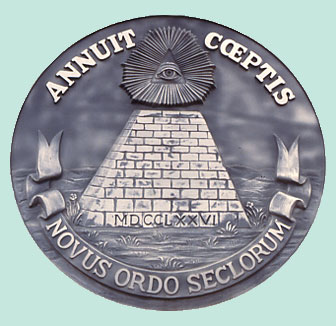

The Great Seal of the United States of America


This new world order sought to make men great in the eyes of God, by giving them the ability to truly be like their Creator.  Instead of having all aspects of life dictated by despots, many getting gain off the backs of the serfs who slaved for them, this new order would allow each person to believe and strive as he or she wanted.  Since the small beginnings in America, we have seen billions of people freed from the enslavement of others.  Any and all people are invited to get out from underneath the pyramid’s base - the enslavement of modern Pharaohs, and climb it to the “all seeing eye” of knowledge and of God.

  The Bible and other Holy Scripture

Just as in Lehi’s vision, he was given a book by the Lord to read (1 Nephi 1) and would then receive the Brass Plates of Laban as the guide for his people, so Nephi would see a book that would be read, the Bible.  He sees, in fact, that they are similar to the Brass Plates, though they are missing important pieces of God’s truth.  Interestingly, Nephi would be commanded to add to that truth by writing his own spiritual story.

The books of the Bible were pure when they “came forth from the mouth of a Jew”, but were later changed in the days of Gentile Christians.  What does it mean when the verse says “a Jew”?  Does it generally mean the Hebrew prophets and Christian apostles that wrote?  Or is it the specific words of “a Jew”?  Perhaps the Jew referred to is Jesus Christ, as he would have guided each prophet in the writings of the future Bible.

“Wherefore, thou seest that after the book hath gone forth through the hands of the great and abominable church, that there are many plain and precious things taken away from the book, which is the book of the Lamb of God.

And after these plain and precious things were taken away it goeth forth unto all the nations of the Gentiles; and after it goeth forth unto all the nations of the Gentiles, yea, even across the many waters which thou hast seen with the Gentiles which have gone forth out of captivity, thou seest—because of the many plain and precious things which have been taken out of the book, which were plain unto the understanding of the children of men, according to the plainness which is in the Lamb of God—because of these things which are taken away out of the gospel of the Lamb, an exceedingly great many do stumble, yea, insomuch that Satan hath great power over them” (1 Ne 13:28-29).

It is not so much that things were changed in the Bible, but things were left out.  Is there evidence that the Bible is missing books?  Yes.  In the early days of Judaism and Christianity, there was not a standard list of scriptures.  Different Jews and Christians in different areas had a variety of books they used, many of which did not make it into today’s official list of books of the Bible.  Today, we note that Catholics regard the Apocrypha as holy scripture, even though the Protestant world does not.  Among the Dead Sea Scrolls, all the Books of the Old Testament were found except Esther, and then hundreds more spiritual books were also found as well. These other books were sacred scriptures for the Essene Jews in Jesus’ day.  The Book of Enoch was important to both Jews and Christians.  It is quoted or referenced in the New Testament 39 times (cf Jude 1:14-15).  The Shepherd of Hermas was used by many Christian sects in the first several centuries of Christianity, but was rejected by St Jerome for not being written by one of the apostles.  There are many other examples of missing scripture, as well.

In this displacement of important texts, many plain and precious teachings were lost, which traditional Christianity has struggled with over the centuries.  By 325 AD, Christians and their leaders were arguing over whether there was just one God of three persons (Trinity) made of pure spirit substance (Bishop Athanasius), One God the Father, and Christ the Lord as separate beings and since there is only one God, Jesus is not a God (Bishop Arius), or that the Father and Son are both Gods and separate beings, with Christ as a subordinate God to the Father (Origen, Eusebius).  Other issues, such as deification of man, monotheism vs monolatry, baptism for the dead (1 Corinthians 15:29), faith vs works, grace, priesthood authority, and many other issues were fought over time after time.

The Great Apostasy

Nephi foresaw what Mormons call the “Great Apostasy.”  While some Church leaders in the past have stated that it was a “total apostasy” that occurred, a close study of the scriptures and of history will show this is not the case.  Had there been a “total apostasy” there would have been no Bible teaching of Christ and the commandments.  There would have been no people on earth calling themselves “Christian” or that prayed to God that they would be forgiven through the atonement of Christ.

Clearly, the apostasy was not a complete one.  Many good truths and teachings survived over the centuries in traditional Christianities.  Some groups embraced more of God’s truth than others.  For those with greater truth would come greater blessings and rewards in heaven.  Yet, there were many key things missing.  The Bible was organized because the proto-orthodox Christian church sought to eliminate their competitors (such as the Gnostics) and the writings they used.  This required a hard decision: rejecting any new claims of revelation.  The Bible would be sealed, and no more scriptural revelation would be allowed.  It also meant that only the books that managed to get through the sometimes political process of selecting books would be officially sanctioned.  St Jerome was on the cusp of rejecting Hebrews and Revelation, except the Western Church insisted on retaining them. If he wanted his list of books to be approved, he would have to include them.  Meanwhile, other books were rejected simply because the Gnostics or others used them.

In eliminating official revelation, the Church had to find another means to establish doctrine and eliminate diversity of scriptural interpretation.  The Nicaea Council of 325 AD established the Trinity as the official view of what God, Jesus and the Holy Spirit are.  Yet, it took another century for it to really be established, as Arius’ teachings still almost won out.  The council did not answer all questions about Jesus.  For example, how could Jesus be only a Spirit, and yet also be a physical being?  The Council of Chalcedon attempted to answer this with the duality of Jesus Christ.

Eventually, there were some issues that just could not be satisfied by a synod, and the universal (Catholic) Church began to unravel.  First, the Great Schism separated east and west, due to the issue of who had the true apostolic authority, the Pope of Rome or the Patriarch of Constantinople.

Centuries later, Martin Luther would write his theses against various Catholic teachings and practices, including indulgences (paying money for one’s sins).  Later reformers would seek to provide the Bible to more people, translating it into German, English and French.  William Tyndale would be executed for translating the New Testament into English.  In speaking with a priest who was against spreading the Bible’s word, Tyndale retorted, “if God spares my life, ere many years, I will cause the boy that driveth the plow to know more of the Scriptures than thou dost!”

Such a prophesy!  Not many centuries later, the farm boy Joseph Smith, Bible in hand, would bring about a revolution in the restoration of all those lost teachings of old!  “I will be merciful unto the Gentiles in that day, insomuch that I will bring forth unto them, in mine own power, much of my gospel, which shall be plain and precious, saith the Lamb” (1 Ne 13:34).  The Lord would then bring forth the Book of Mormon, primarily for the Lamanites, but also for the Gentiles.  But the Lord would not only stop at the Book of Mormon.

“And after it had come forth unto them I beheld other books, which came forth by the power of the Lamb, from the Gentiles unto them, unto the convincing of the Gentiles and the remnant of the seed of my brethren, and also the Jews who were scattered upon all the face of the earth, that the records of the prophets and of the twelve apostles of the Lamb are true” (1 Ne 13:39).

When Mormons read this chapter, they normally think the other books refer to their additional scriptures: Doctrine and Covenants and the Pearl of Great Price.  These would be included in the list.  But since its publication in 1830, many ancient books have come forth that have increased our understanding of ancient Israel, early Christianity and the Lord Jesus Christ.  These include the Dead Sea Scrolls, Nag Hammadi library, and hundreds of other early Jewish and Christian texts that have been discovered since the days of Joseph Smith.  These also are brought forth to enlighten us in our day, and to be as a witness of God, Christ, and the many precious and plain things that were lost long ago.  Here we see a prophesy from the Book of Mormon literally fulfilled in our day!

The Great and Abominable Church versus the Saints
1 Nephi 14

Nephi’s vision continues to see that curses and blessings will fall upon the Gentiles, depending on their humility and obedience to the Lord.  Again, the great and abominable Church is mentioned. It will fight against the Church of Christ.  What is the Church of Christ?  I believe it has two connotations.  First, it is the fully restored gospel of Jesus Christ found in the Church of Jesus Christ of Latter-day Saints.  It is “the only true and living church upon the face of the earth with which I, the Lord, am well pleased” (D&C 1:30).  This does not mean that it is the only true (correct teachings) church, nor the only living (indwelling of Spirit) church.  It means it is the only one with which the Lord is “well pleased”, and that is because it has accepted the plain and precious things that were once lost.

As mentioned before, each church and person who follows its tenets will be blessed for the truths they embrace.  The more truths, the greater the blessings.  When one church has greater truth, it is a notch above the others.  The Church of Jesus Christ of Latter-day Saints contains the restoration of many ancient truths, and so is a notch above the rest.

That said, the second meaning for the church of Christ is any and all churches that accept Christ as Lord and Savior, and embrace Christian truths of righteousness.

In the last days, not only the Mormons (who have a history of being persecuted), but many Christians will find themselves persecuted by the Great and Abominable Church.  Their religious freedoms will be threatened or destroyed by unbelievers, who seek to get gain and power at any cost.  Yet the saints of God will be protected by the power of God in those days.  LDS believe that the Lord will help us build sanctuaries of righteousness, if necessary, in the midst of the wicked.  These will be cities of safety and refuge which will be shared with other good people of faith.  Working together, we will build little Zions as refuges from the storm.  In the end days, the Lord will then destroy the evil in the world, and the church of getting gain will be no more.


John the Revelator and Nephi the Revelator

After seeing the wicked destroyed, Nephi learns that the vision he has received (including many things he cannot share with us) were also revealed to John the Revelator and others.  The apostle John was given the responsibility to witness of the last days, and therefore Nephi was commanded not to elaborate on the rest of what he saw.  Still, the things Nephi taught us in his Vision of the Tree of Life (1 Ne 11-15)) are important for understanding how to understand John’s Revelation, or at least Nephi’s version and understanding of the Revelation of John.

What we do see from this vision is that for modern Gentiles and Lamanites alike, we live in the last days.  Each one of us must choose whether to stay at the Tree of Life and partake of its fruit of love and redemption, or look across the gap toward the great and spacious building of pride.

As we reach the end days and the Coming of the Lord in glory in our own day, greater disasters will occur and the great and abominable church of men seeking gain through murder and larceny will grow ever bigger.  It may be made up of many organizations and people, but their focus is all the same: getting power and wealth through any means necessary.  We may well see the freedoms that now spread across much of the world, end in many places due to the political and evil actions of the abominable church.

In the Book of Mormon, we will see many examples of how the righteous are preserved, by repenting, believing on Christ’s name, following his example, and uniting together as a family of saints.


Bibliography

Dead Sea Scrolls - Wikipedia:   http://en.wikipedia.org/wiki/Dead_Sea_Scrolls

Five Dead Sea Scrolls available online: http://dss.collections.imj.org.il/

Dead Sea Scrolls translations online: http://www.gnosis.org/library/scroll.htm

1 Book of Enoch: http://www.sacred-texts.com/bib/boe/

Shepherd of Hermas: http://www.earlychristianwritings.com/text/shepherd-lightfoot.html

Early Jewish Writings: http://www.earlyjewishwritings.com/

Early Christian Writings: http://www.earlychristianwritings.com/

William Tyndale: http://en.wikipedia.org/wiki/William_Tyndale

Friday, December 30, 2011

Book of Mormon Gospel Doctrine lesson 3 “The Vision of the Tree of Life” 1 Nephi 8-15


Book of Mormon Gospel Doctrine lesson 3  “The Vision of the Tree of Life”  
1 Nephi 8-15

The teacher’s manual discusses much of the standard symbolism in the Vision that both Lehi and Nephi experienced regarding the Tree of Life.  While the manual divides this lesson differently (chapters 8-9 are covered in lesson 2), I will add it to Nephi’s vision so that the two may be compared and contrasted.  This discussion will focus on key parts of the experience, focusing on  ancient roots and how for Lehi and Nephi it was a temple endowment.

Lehi’s Vision
1 Nephi 8-10

As mentioned in previous lessons, Lehi is a future symbol of Abraham.  In his vision, much of the focus will be establishing his family in the promised land, just as Abraham was led to his own promised land in Canaan.

Lehi’s vision begins with him sharing his concerns for his family, and especially for Laman and Lemuel.  His discussion then switches to the beginning of the dream, where he found himself in  “a dark and dreary wilderness” (1 Ne 8:4).  Ancient and modern temple rites take us through a representation of trying and difficult times.  Such a dark place would represent what the Fall of Adam has caused for Lehi and his family.  They have left Jerusalem and the temple, which once symbolized God’s presence, and has left on a journey in a dangerous wilderness.  Their stop at the Valley of Lemuel was necessary, as verse one states they had to gather food for the next leg of their journey.  Perhaps they remained several months, in order to grow such things in a rare oasis in one of the driest places on earth.  

He found himself cast out of the Presence of God (Shekinah) both in the dream and in real life.  He is in a fallen world, what LDS would call a Telestial state.  His real life and dream symbolize Abraham’s departing from Ur of Chaldees, which was a grand and powerful place, and entering into the unknown deserts and wilderness of Canaan and Egypt.  Abraham would also have stopped often along the way in order to provide food as he continued his journey as a wanderer in a strange land.
“And it came to pass that I saw a man, and he was dressed in a white robe; and he came and stood before me.And it came to pass that he spake unto me, and bade me follow him.And it came to pass that as I followed him I beheld myself that I was in a dark and dreary waste.And after I had traveled for the space of many hours in darkness, I began to pray unto the Lord that he would have mercy on me, according to the multitude of his tender mercies. And it came to pass after I had prayed unto the Lord I beheld a large and spacious field” (1 Ne 8:5-9).

In many ascension/theophany/temple experiences, the person is met by an angelic guide.  In the Apocalypse of Paul, the Holy Ghost appears as a child to guide him in his ascension experience.  In the Book of Revelation, John is guided by an angel of great power and holiness. So powerful is this angel that John falls down to worship him (Rev 19:10). In the Ascension of Isaiah, the prophet is also guided by an angel in his ascent through the heavens.  Interestingly, in Nephi’s Vision of the Tree of Life, he is guided by the Holy Ghost in the form of a man, similar to Paul’s apocalypse.

It is very possible that the “man in the white robe” which Lehi saw was the Lord.  Lehi symbolizes Abraham, who while in the wilderness was visited by three men in white, one possibly being Jehovah (Genesis 18).  One LDS scholar, David Larsen, suggests that the being may have been the translated king Melchizedek, a symbol of Jehovah/Jesus Christ.  This concept derives partially from from the Melchizedek scroll of the Dead Sea Scrolls (11QMelchizedek), where it is proclaimed, “Melchizedek is Yahweh” and “Melchizedek is El.”

Is it possible that Lehi’s guide was Jesus Christ, Abraham, or some other individual symbolizing Christ?  That Lehi began praying to the Lord as he remained in the dark and dreary wasteland suggests that he may have prayed to the holy messenger he was with, again suggesting that the angel was Jesus.

It is when he prays to the Lord that the lights come back on, and Lehi is able to see all that is going on around him. Clearly, he has taken the first step in returning into the presence of the Lord’s glory, as he has prayed in faith. Lehi sees a big field, which represents the world we live in.  But then he sees his objective: the Tree of Life.  Note in 1 Ne 8:10 that it is the fruit which makes one happy.  This will be important to remember as we study the Tree’s significance during Nephi’s vision.

“And it came to pass that I beheld a tree, whose fruit was desirable to make one happy. And it came to pass that I did go forth and partake of the fruit thereof; and I beheld that it was most sweet, above all that I ever before tasted. Yea, and I beheld that the fruit thereof was white, to exceed all the whiteness that I had ever seen.And as I partook of the fruit thereof it filled my soul with exceedingly great joy; wherefore, I began to be desirous that my family should partake of it also; for I knew that it was desirable above all other fruit” (1 Ne 8:10-12).

As we study Nephi’s vision, we will learn what the symbol of the fruit means.  However, it is important that we note that this fruit is which makes one happy.  Later, Lehi would teach his son, Jacob, that “Adam fell that men might be, and men are that they might have joy” (2 Ne 2:25), and that it is the Messiah’s atonement that affords us that happiness.  The fruit, therefore, is Christ and his atonement.  True happiness only comes from partaking of the fruit of Jesus Christ by believing on him and repenting of our sins.  This will be a theme that we return to time and again in the Book of Mormon: that true joy comes to those who turn to Christ.

It is at this point, when Lehi partakes of the fruit that he symbolically is in the presence of the Lord. While all mankind must some day return into the presence of the Lord at the judgment bar (Alma 11-12), not all will choose to remain.  Instead, many cast their eyes elsewhere and are lured away by worldly enticements and attitudes, such as those represented by the people in the great and spacious building.  These are people who mock holy things and use peer pressure to cause us to turn our backs on Jesus and the happiness he offers us.  Many fall away from activity and faith in the LDS Church and other forms of Christianity.  They believe it to be too restrictive, too old-fashioned, or too worldly to desire to be lifted to a higher plain of happiness.  Many are lost in mists of darkness, following paths that lead them further and further away from the light, and deeper into the darkness which Lehi had just escaped by praying to the Lord for rescue.  And that is what it requires for each of us, a rescue.  We are all fallen from God’s presence.  Only through Christ can we return to His presence.  Only through continued faith and repentance may we remain in God’s presence.

Immediately, Lehi’s dream becomes personalized, as he focuses it on his own family.  The fruit of the Tree of Life is wonderful, and he wishes to share it with them.  He finds his wife, Nephi and Sam in one place, near the head of the river, eager to join him.  But Laman and Lemuel do not heed their father.  They are satisfied with what the world has offered them.  Later they will speak admirably of Jerusalem and its inhabitants, and condemn their father and Lehi for leading them away.

Lehi’s rod of iron, which Nephi will interpret to be the “word of God” has important ancient symbolism.  Matthew L. Bowen explained that in Egyptian, the term mdw  means both “staff” and “to speak”.  The term mdw-ntr meant divine revelation or sacred writing.  So the “rod of iron” means both a literal rod to grasp onto, but it also means divine revelation or writing.  The LDS children’s song, “To Nephi, Seer of Olden Time”, which states the “iron rod is the word of God” is literally correct.

Lehi’s tale ends with him exhorting his older sons, pleading with them to believe and turn to God. His is a vision of a small family striving to seek the promised land, the Tree of Life, the presence of God.

Nephi’s Vision of the Tree
1 Nephi 11-15

Nephi desired to “know the things my father had seen.”  As with his father, his journey begins with meditation and prayer near the beginning of it.  As he pondered, the Holy Ghost lifted him to a high mountain. Whenever a person in scripture or in ancient Jewish/Christian writings has an experience on a high mountain, one knows it will be a temple-like experience, where the person is prepared to enter God’s presence and glory (Matthew 17, Revelation 21:10).  We see this in the Apocalypse of Paul, with Moses’ ascent of Sinai, and the brother of Jared as he saw Christ.

We learn something important regarding the Holy Spirit - he is human-like in form, for Nephi spoke with him as a man talks to another man.  The Spirit tested Nephi’s faith prior to giving him such a powerful experience.  He was asked if he believed his father’s Lehi’s words, and in God.  The Spirit then testified of the Father and Son, which is his main responsibility to mankind.  Then the Spirit probed him, to see what things he already understood (1 Ne 11:3-6)
An interesting dialogue occurs between Nephi and the Spirit.  The Spirit tells him that after seeing the Tree of Life, he would see the Son of Man descend from heaven.  Upon seeing the tree, Nephi asked to know the interpretation of it.  The Holy Spirit then showed him the virgin Mary.  Nephi still was not sure of the interpretation.

“And he said unto me: Behold, the virgin whom thou seest is the mother of the Son of God, after the manner of the flesh.And it came to pass that I beheld that she was carried away in the Spirit; and after she had been carried away in the Spirit for the space of a time the angel spake unto me, saying: Look! And I looked and beheld the virgin again, bearing a child in her arms. And the angel said unto me: Behold the Lamb of God, yea, even the Son of the Eternal Father! Knowest thou the meaning of the tree which thy father saw? And I answered him, saying: Yea, it is the love of God, which sheddeth itself abroad in the hearts of the children of men; wherefore, it is the most desirable above all things” (1 Ne 11:18-22).

Why is it that upon seeing Mary with the baby that suddenly he understood the Tree of Life to mean the love of God?  Here we come to an ancient Jewish belief that was lost from the temple in the days of King Josiah and the Deuteronomist reforms.  In reforming the religion, many things were removed from the temple, including the Tree of Life, angels, and being in the presence of God (Shekinah).  

Anciently, it was believed that God had a wife or consort, named Asherah.  She was known to be the goddess of wisdom and fertility (love).  Archaeologists have found evidence of her as being a part of the worship of both Elohim and Yahweh. In Proverbs, she is known as Wisdom (Proverbs 8).  Lost from the temple teachings in Lehi’s day, the concept of Asherah, the Tree of Life, the wife of God would have stood out in the Brass Plates and recognized immediately by Nephi.  In speaking of this at the 2005 Library of Congress, Joseph Smith Symposium, Old Testament scholar Margaret Barker noted that such a teaching in the Book of Mormon was perfectly understood and accepted in 600 BC.

In seeing the mortal mother of God represented by the Tree of Life, Nephi understood that the Tree of Life signified the wife of God, or Heavenly Mother as LDS call her, shedding forth her fruit that would make one happy.  The fruit was white beyond description and was the thing that gave spiritual life and joy.  The fruit is Jesus Christ.

   Condescensions of God

Nephi is shown two condescensions of God, or two times when God descends below mankind. (1 Ne 11:16, 26).  The first was a condescension of both Father and Son in bringing forth the birth of Jesus through a mortal mother.  Jesus would descend from his throne on high, and become mortal, leaving the Father behind.  The second was at Jesus’ baptism, where the Lord of all set the example of baptism for all the rest of us to follow.  Though he was perfect, he was baptized to fulfill all righteousness and the will of the Father.

The condescension continued as Christ walked the earth, taught and healed during his ministry - the King of Israel as the humble servant, and then suffered physical and spiritual death (My God, why hast thou forsaken me?) in the Garden and on the Cross, so that we may be lifted up by him.

In death, he descended into the catacombs of the dead, where he opened the prison doors and brought forth the First Resurrection.  Such was the condescension of God.

The Future Nations

While Lehi’s vision focused primarily on his family, and linked him symbolically to Abraham, Nephi’s vision will link him to Joseph or Moses, leaders not only of families, but of nations.

Nephi’s vision follows the timeline of the Nephites, where he sees the future division of the people, their wickedness and their repentance at the coming of Christ to his people.  He then witnessed the Nephite destruction and the survival of the Lamanites, who would remain in the dark and dreary wilderness until a future restoration would occur.

Unlike Lehi’s vision that focused on his family, Nephi’s vision takes him further to see the nations of the Nephites and Lamanites, the coming of the others, and the Second Coming of the Lord.  His is a an expansive vision with an entirely different focus than that of his father’s.  

He sees the coming of the Gentiles to the promised land, with Columbus inspired to cross the ocean, even as his father Lehi was inspired to do.  He foresees the land of liberty and the day when the Gentiles would fall into sin, becoming like the wicked Lamanites, living in a telestial state outside the presence of God, and losing the blessings of the promised land (1 Ne 12-14).

A discussion ensues regarding the two churches: that of God and the Devil.  The great and abominable Church has sometimes been believed to be the Catholic Church and perhaps the Protestant religions that broke away from it.  However, we see that Nephi described the abominable church as one that led men’s souls to hell.  According to LDS belief, this cannot include these faiths, as they do not lead men down to hell.  Instead, they call people to Christ, and are among the honorable men of the earth which shall inherit the Terrestrial kingdom (D&C 76).  Instead, we should see the great and abominable Church as any organization that leads people away from Christ, down paths of destruction.  We shall see in the Nephite record that this includes organizations that resemble Gadianton Robbers, who seek to get gain and power by any method necessary, including theft and murder.  Among other places, these can be found as gangs, business organizations, or even in government, if such organizations seek power and gain and are willing to murder to obtain or maintain that power.

Interestingly, Nephi is told that his vision is like that of John the Revelator, and is commanded to not write most of the vision, because it was assigned to John to write it.  That John’s Revelation is an ascension text was discussed my 2011 New Testament lessons on Revelation.  There is a big connection between the Book of Revelation and Nephi’s Vision of the Tree of Life.  Perhaps reading them together may bring forth interesting insights into both.

In 1 Nephi 15, Nephi notes he returned to his father’s tent.  Again, the tent represents the center of their universe.  It is where they council, and where Nephi explains the vision to his brothers.  It is akin to Moses’ Tabernacle, as a sacred place in the wilderness, where the family may receive revelation.


Bibliography

Apocalypse of Paul: http://www.gnosis.org/naghamm/ascp.html

Ascension of Isaiah: http://www.earlychristianwritings.com/text/ascension.html

The Dead Sea Scrolls in English, by Geza Vermes: http://www.amazon.com/Complete-Scrolls-English-Penguin-Classics/dp/0140449523/ref=sr_1_1?s=books&ie=UTF8&qid=1325182867&sr=1-1

David Larsen’s Heavenly Ascent blog on the Three Men who visited Abraham: http://www.heavenlyascents.com/2010/02/19/the-three-men-who-appeared-to-abraham-the-godhead-angels-or-human-beings-old-testament-lesson-8/

“What meaneth the Rod of Iron?”, Matthew L. Bowen: http://maxwellinstitute.byu.edu/publications/insights/?vol=25&num=2&id=421

Hymn: “To Nephi Seer of Olden Time” (Hold to the Rod): http://lds.org/churchmusic/detailmusicPlayer/index.html?searchlanguage=1&searchcollection=1&searchseqstart=274&searchsubseqstart=%20&searchseqend=274&searchsubseqend=ZZZ

“God’s wife edited out of the Bible - almost” where scholars discuss Asherah and the changes in Judaism in Lehi’s day:  http://news.discovery.com/history/god-wife-yahweh-asherah-110318.html

“Nephi and his Asherah” by Daniel C Peterson: http://maxwellinstitute.byu.edu/publications/jbms/?vol=9&num=2&id=223

My Old Testament article on Proverbs, where I discuss Wisdom as the wife of God: http://joelsmonastery.blogspot.com/2010/08/ot-gospel-doctrine-lesson-31-happy-is.html

Margaret Barker at Joseph Smith Symposium (session 2, second speaker): http://lds.org/library/display/0,4945,510-1-3067-1,00.html

Monday, December 26, 2011

Book of Mormon Gospel Doctrine Lesson 2 “All Things According to His Will” 1 Nephi 1-7


Book of Mormon Gospel Doctrine Lesson 2 “All Things According to His Will”
1 Nephi 1-7

Lehi’s Theophany
1 Nephi 1:5-20

As discussed in lesson 1, the Book of Mormon is a book of ascension, or a “How to” book on returning into the presence of God, which is what a theophany is: standing in God’s presence.

Lehi went to the Lord to pray for the people, whom the prophets called to repentance. In praying for others, he received an unexpected vision and experience.

The first part of the vision occurred as he prayed for the people in the wilderness.  As he prayed, a “pillar of fire” appeared on a rock, where “he saw and heard much”.  From the very beginning, Lehi takes the role of Moses, who also initially saw God as a pillar of fire or burning bush.  This is an importance symbolism, because Moses’ goal at Sinai with the Israelites was to have them all purify themselves and ascend the mountain into the presence of God (D&C 84:19-26).  For Lehi, this would be his work for his family, and would continue into succeeding revelations, but first beginning with himself.

Later, after returning to Jerusalem, he experienced another vision.  In this one, the heavens opened and he saw God sitting on his throne, with the divine praising God.  In this instance, Lehi experienced his theophany, seeing God.  Not only that, but he saw the divine council that other prophets also experienced in their theophanies (Isaiah 6:1-8, Rev 4:1-6).

Lehi’s vision continues, wherein he saw One descend from heaven.  Twelve others followed him down and spread across the earth.  These were divine beings, as Lehi notes their luster: The first one, Jesus Christ, shown greater than the sun, while the Twelve apostles shown brighter than the stars of heaven.  It could also be that the Twelve shown brighter than many of the other heavenly beings, also known as the “morning stars” (Job 38:7).  The descended Lord gave him a book to read, wherein he was filled with the Spirit and prophesied of Jerusalem’s destruction by the Babylonians.

Lehi exclaimed,
“Great and marvelous are the works, O Lord God Almighty! Thy throne is high in the heavens, and thy power, and goodness, and mercy are over all the inhabitants of the earth; and because thou art merciful, thou wilt not suffer those who come unto thee that they shall perish!” (1 Ne 1:14).

He spoke directly to Almighty God (Hebrew: El Elyon), who he just saw seated on His throne. He understood the mercy he showed forth to those who rebelled, sending many prophets to them, and giving them many opportunities and generations to repent.  Lehi also understood the Lord granting blessings to the obedient, not allowing them to be destroyed.  This would foreshadow his own escape into the wilderness with his family.

Although his visions were very abbreviated by Nephi, Lehi’s visions are very similar to an ancient Jewish/Christian text called the Ascension of Isaiah.  In the Ascension of Isaiah, the prophet ascends through ten levels of heaven, seeing the increasing glory of the angels that dwell in those levels.  Isaiah entered the throne room, where the highest angels worshiped God, Christ and the Holy Ghost.  Isaiah is dressed in white, so as to be able to be in the higher levels.  In the seventh heaven, he is given a book to read.

“21. And whilst I was still speaking with him, behold one of the angels who stood nigh, more glorious than the glory of that angel, who had raised me up from the world.22. Showed me a book, [but not as a book of this world] and he opened it, and the book was written, but not as a book of this world. And he gave (it) to me and I read it, and lo! the deeds of the children of Israel were written therein, and the deeds of those whom I know (not), my son Josab” (Ascension of Isaiah, chapter 9:21-22).  

Here, we see that he reads about Israel, just as Lehi read about Israel in his day. John the Revelator would also receive a book, which he would eat (read), telling of his mission to the lost tribes of Israel.

And, as with Lehi, Isaiah saw Christ descend through the levels of heaven on his way to earth.  On reaching each level, Jesus’ glory lessened, so that those around him could tolerate his presence..

Lehi then preached repentance to the inhabitants of Jerusalem.  Here, he would have shared his visions with them, and the things he read in the book, regarding Jerusalem’s fate if they did not repent.  Such teachings went directly against the beliefs of the day.  Since the days of Josiah, the temple priests had changed worship both inside and outside the temple. Such changes were discussed in  lesson 1, the Mosaic Law and the work of the temple had been changed. The temple no longer was a place that prepared people to be in the presence of  God and his angels.  Instead, it was a place of animal sacrifice, and nothing much more.  The people needed to repent and make major changes to their religion, including the temple worship.

Lehi in the Wilderness
1 Nephi 2-7

Lehi traveled down near the borders of the Red Sea, along what is known as part of the Spice or Incense Road.  It connected Egypt with the Mediterranean and eastern spice areas.  Normally, the route was taken by large caravans, to ensure protection from bands that awaited.  Lehi’s small band didn’t have that option.  So, while they traveled near the route that followed the Red Sea, they probably stayed off the main trail for protection.  Later, Nephi will note that they did not have fires in the wilderness, but ate their meat raw.  This also was probably due to the dangers of robbers along the routes taken.

After three days, Lehi and family camped.  Here, he named the valley Lemuel and the river that emptied into the Red Sea, Laman, after his eldest sons. It is possible that the Valley of Lemuel was recently discovered (1995), in a narrow canyon with a river that does not go dry in the dry season.

“And my father dwelt in a tent” (1 Ne 2:15).

Why was it so important for Nephi to tell us several times that his father dwelt in a tent?  Shouldn’t it be obvious? Only to one understanding the ancient symbolism.  It is what is implied, but not said that tells us what this means.  In conjunction with dwelling in a tent (1 Ne 7:22) we find that Lehi built altars in the wilderness and offered sacrifice upon them.  As did the patriarchs Abraham, Isaac, Jacob and Moses, Lehi was a prophet in the wilderness. He lived a nomadic life, leaving behind the comforts of the city (as did Abraham in leaving Ur, or Moses in leaving Egypt).  The tent became a place of council and revelation.  For Abraham, the three angels (including Jehovah) came to his tent to council regarding Sarah’s pregnancy and the destruction of Sodom and Gomorrah. For Moses and the nation of Israel, the tent would be expanded into a Tabernacle, a portable temple, where prophets and priests would council with God.

Lehi’s tent was their Tabernacle as they traveled through the wilderness.  Lehi was Abraham and Moses in the journey to the promised land.

While Jerusalem had rejected the ancient temple rites and the wilderness altars of Abraham and Moses, Lehi embraced these ideas.  He returned to his roots, which was the right way to worship God.  Why? Because it led people to God’s presence and the promised land.  The physical promised land symbolized the heavenly promised land we should all seek.  In receiving his own testimony of Lehi’s visions, Nephi was told:

“ 20 And inasmuch as ye shall keep my commandments, ye shall prosper, and shall be led to a land of promise; yea, even a land which I have prepared for you; yea, a land which is choice above all other lands. 21 And inasmuch as thy brethren shall rebel against thee, they shall be cut off from the presence of the Lord.” (1 Ne 2:20-21).

Here we see a dual prophesy. The righteous prosper both temporally and spiritually, being led to promised lands on earth and in heaven.  But the wicked are “cut off from the presence of the Lord.”  The people of Jerusalem, once a proimsed land, had rejected God’s covenants he made with Abraham in the wilderness, and now were cut off from God’s presence.  And in refusing to repent, they would not return into God’s presence in the heavens, either.  Again, we see the importance of the ascension into God’s presence, not only of the individual, but also the family (Lehi’s) and of the nation (Israel).

While Lehi would symbolize Abraham and Moses, Nephi would also symbolize ancient patriarchs.  In the ancient Middle East, the eldest son normally was the leader. Yet, as with Isaac and Jacob, Nephi was chosen to lead his older brothers. A special trip is made to find a wife for Nephi and his brethren, even as Abraham sent his servant to find Rebekah for Isaac, or Jacob leaving home to find his wives Leah and Rachel.

The Brass Plates
1 Ne 3-5

As mentioned in the first lesson, it is possible that the Brass Plates of Laban were the source for the “E” or Elohist scripture from the Northern Kingdom of Israel.  The plates were very important to both Lehi and Laban.  

For Laban, they were a source of unique power.  He may not have been a rich person, as he lusted after Lehi’s treasures brought to him by Nephi.  But the plates were used not only by Laban, but by the elders and leaders of Jerusalem.  When Nephi, disguised as Laban, told Zoram to retrieve them, Zoram did not seem to question taking the plates out in the middle of the night, or of talking about the “brethren” of the faith.  The “brethren” would have been the leaders of the community, including the temple priests.  They would have consulted the writings frequently, especially in dangerous times, such as the impending Babylonian invasion.  The texts, being from the Northern Kingdom, would be useful in showing them what things they should do concerning an invasion, as the Brass Plates probably would have included prophetic warnings, and perhaps historical texts concerning the kingdom’s destruction by Assyria.

For Lehi and his family, it would be necessary to have the plates in order to teach their children, and prevent them from falling away from God and towards destruction.  In fact, as Lehi studied the plates, he noted his genealogy, descending from Joseph, one of the early patriarchs.  Perhaps the plates guided him in the wilderness, on developing a religion for his family that would return them to the ancient worship: altars, animal sacrifice by non-Levites, and using his tent as a mobile Tabernacle or center for the council.

Divine books were definitely an important thing for Lehi, as the divine book given to him by the Savior helped him see the future of Jerusalem, and now the Brass Plates would guide him towards the ancient religion and a return to true worship, as he and his family prepared to travel towards the Promised Land and into the presence of the Lord.

Bibliography

Ascension of Isaiah: http://www.earlychristianwritings.com/text/ascension.html

Lesson one, part one: http://joelsmonastery.blogspot.com/2011/12/book-of-mormon-gospel-doctrine-lesson-1.html

Lesson one, part two:
http://joelsmonastery.blogspot.com/2011/12/book-of-mormon-gospel-doctrine-lesson-1_16.html

Valley of Lemuel found?  http://maxwellinstitute.byu.edu/publications/jbms/?vol=8&num=1&id=185

Feast Upon The Word Book of Mormon lessons: http://feastupontheword.org/Site:SS_lessons#Book_of_Mormon_lessons

Saturday, December 17, 2011

Review: “A Most Remarkable Book” video

Review: “A Most Remarkable Book” video


Tyler Livingston recently asked me to review his new FAIR production, “A Most Remarkable Book”, about the Book of Abraham.  Previously, due to replication issues, I was sent the DVD case, but not the DVD itself, and so provided a tongue-in-cheek review of the cover.

Being a good sport, Tyler still decided to send me the DVD (now I have two cases), hoping for an in-depth review of the actual film.  I was excited to review the video, to see how in-depth they would go on a variety of issues tied directly or indirectly to the Book of Abraham.  For someone wanting to see the LDS arguments relating to the Kirtland Egyptian Papers, you will have to look elsewhere.  There are many good papers and discussions on it at Foundation for Apologetic Information and Research (FAIR), Kerry Shirts’ Backyard Professor website, and Mormon Dialogue forum..  Rather than an intensive scholarly work, this video is made for the average viewer to gain an understanding on some complex issues on a more basic level.  The focus of the discussion is on the papyri itself, and the text’s and facsimiles’ ties with modern archaeological evidence.

The Book of Abraham is a very controversial book, found in the Pearl of Great Price, one of the four books of the LDS canon. The video explains the beginnings of the story in our day: papyri scrolls and mummies found in Egypt during the era when Egyptian artifacts were all the rage. The items found their way to Joseph Smith, who stated that some of the writings claimed to be of Abraham and Joseph, the ancient patriarchs of the Bible.  Joseph Smith translated at least a portion of Abraham’s writing, and on three facsimiles wrote  notes regarding items found in the drawings.  Most of the scrolls were lost in the great Chicago fire, while a few fragments and an 8 foot long scroll were rediscovered in 1967.

The video includes a narrative setting, with good quality shots of mummies, papyri (those in Church possession, and many others), and some nice pastoral scenes to make segues between topics.  There are several LDS scholars interviewed or referenced in the DVD, including: Kevin Barney, John Gee, Michael Ash, Kerry Muhlstein, Jared Ludlow and David Bokovoy.  On another review, someone said he would liked to have seen Kerry Shirts in the video. Kerry Shirts and his work were mentioned, but did not appear in the DVD. As I thought about it, I figured it was probably a good thing, as he tends to explain things on very technical and detailed levels, often requiring an intermediary to interpret it. (Kerry, you can thank me later).

The video includes a variety of topics, including: the age of the Joseph Smith papyri, the Missing Papyri Theory, the Jewish Redactor Theory, a focus on the three Facsimiles, Evidences for the Authenticity of the Book of Abraham, Egyptian language and concepts not known in Joseph Smith’s day, Geographical locations from the Book of Abraham found, Astronomy, Geocentric View of the Book of Abraham, the Council of Gods, and finally the importance of a spiritual testimony of the book.

The video does tell us that the scrolls date to 200 BC, and not to Abraham’s time. It may be they are copies of copies. The fragments we now have do not translate directly into the Book of Abraham, but include portions of the Egyptian Book of the Dead and other ancient Egyptian writings. For some people, this is “proof” that the Book of Abraham is a fraud. However, there is reason to believe it is not as simple as that.  There is strong evidence that much of the papyri is missing, destroyed in the Great Chicago fire. It is believed that one scroll was perhaps 40 feet long, while the longest scroll now is only eight feet long. It is also known that Egyptian hieroglyphics are able to be translated or symbolized in many different ways.  Perhaps modern Egyptologists interpret the writings one way today, while someone anciently interpreted it in a different way. Such are the two theories brought forth in the video: The Missing Papyri Theory and the Jewish Redactor Theory.  These show good reasons why we need not expect to find a word for word translation of the Book of Abraham. As to the various theories on how Joseph Smith translated (including the Missing Papyri Theory and the Jewish Redactor Theory, I’m agnostic.  While the two theories can both be used simultaneously, it is just as possible that the papyri were a catalyst for Joseph Smith to receive a revelation regarding Abraham.  His concept of translation was quite different than we use it today.  I was just a little disappointed that the Catalyst Theory was not introduced here. The gold plates were “translated” while the plates generally were closed, and Joseph looked through the Urim and Thummim. His “translation” of the Bible included additional information and revelation regarding the Creation, Fall, Enoch, Melchizedek, Joseph and much more.  We do not need to necessarily even have the ancient parchment that the apostle John hid under a rock, available via revelation for Joseph Smith to “translate in Doctrine and Covenants 7.  The Catalyst Theory is not included in the video. Perhaps it was due to time constraints, or the producer did not want to overwhelm the viewer with too many theories.  Then again, it is possible that those involved may not give as much credence to this theory.

The three Facsimiles found in the Book of Abraham, including notes by Joseph Smith explaining various aspects within them was insightful, scholarly, yet easy enough for the average viewer to understand.  “Kolob”is an Egyptian term “QLB”, which means “center”, fitting perfectly with the star Kolob being at the center of God’s creations. Terms introduced by Joseph Smith, such as “gnolaum”, “Raukeeyang”, “Shinehah” and others are also discussed, showing that Joseph Smith did not just guess at terms, even though Egyptian hieroglyphics were just being figured out by Champollion in this same period.  Frequently, the scholars note that Joseph Smith’s high frequency of “guessing” correctly shows that it is more than just luck involved.

Interestingly, they included discussion on the ancient Council of Gods.  On my blog at joelsmonastery.blogspot.com, I often discuss the ancient divine council, and so was thrilled to see a few minutes spent on one of the most important concepts we get from the Book of Abraham. In the Book of Abraham, we find that God is surrounded by his spirit children, who are divine “great ones” and “rulers”.  They actually help him design and create the earth we now live on.  Abraham was told that in the premortal life, he was one of the noble and great ones. This was definitely one of the key steps in Joseph Smith developing his understanding of theosis: man becoming like God. Such a concept, as explained in the video, was very foreign to 19th century Christianity, which believed in a strong monotheism.  However, recent studies by both LDS and non-LDS scholars show that the ancient patriarchs did believe in a divine council of Gods.

This video was made for the average reader/viewer. Its purpose is to explain some of the complexities of the Book of Abraham, since there is so much turmoil going on about its authenticity by naysayers and doubters.  I think it does a terrific job of explaining many complex issues in a way most people can understand. On a scale of 1 to 10, with 1 being a dunce and 10 being Professor Daniel C Peterson, I’d rate the video as a 5 or 6 on the intellectual scale.  A college degree is definitely not necessary, although it may stir within many people the desire to look closer at the Book of Abraham, and perhaps deeper study into the ancient Middle East.

The video ends with several of the scholars explaining that what is most important to them is the spiritual witness each has received of this remarkable book.  The physical evidences they share in the video only strengthens their spiritual witness, without supplanting it.  And here lies the strength of the Book of Abraham when there are so many websites and books against it. Just as with the Bible’s stories of Noah’s Flood or Jesus’ resurrection, we cannot “prove” the Book of Abraham to be true via physical evidences.  We can only show that there is much evidence supporting it as an ancient text.  The real power of the book comes from the Spirit, and it is an excellent way to close the video.

For those interested in learning more about the Book of Abraham, this video is definitely a keeper. It will not give you a testimony of the book, but it could likely help you gain interested in gaining a witness of it.
You can get your own copy of this excellent video at the Foundation for Apologetic Information and Research bookstore for $12.99.  Not a bad price for a quality documentary on the Book of Abraham.

Friday, December 16, 2011

Book of Mormon Gospel Doctrine Lesson 1 part two “The Keystone of our Religion”


Book of Mormon Gospel Doctrine Lesson 1 part two “The Keystone of our Religion”

Key concepts from the keystone of our religion
More things to consider as we prepare for the Book of Mormon year.  For many Latter-day Saints, the Book of Mormon may be stories of Nephites and Lamanites who have lots of wars, and in the end the Nephites end up destroyed.  There are many levels of symbolism and key doctrine involved in the Book of Mormon.  Here are some major points to consider as we go through the year of study, as they illustrate why the Book of Mormon is the keystone of our religion.

The Book of Mormon as a Prophesy of the Last Days

In general ways, we can see the events within the Book of Mormon as a cycle the world  (and especially the USA) now is going through.

The Book of Mormon tells the story of a people inspired to leave the old world and go to a promised land.  Whether it is Lehi or Christopher Columbus, the Book of Mormon shows inspired men led to find the New World. The Lord blesses the people in the promised land with prosperity, as they remain humble, yet they still must deal with those who hold tightly to the old ways (which include secret combinations).

Various “outsiders” enter into the picture of both the Nephites and America, trying to change the culture from one of righteousness and freedom to one of big government (king men) and wickedness.  We find cycles of righteousness and wickedness.  I recall as a new member in my teens, wondering how the Nephites could switch from good to evil in just a few short years.  Now seeing the world we live in, we can see it occurs in our day, as well.  For example, after the attacks of 9/11, Americans of all faiths and political beliefs humbled themselves, having days of prayer and repentance, united in moving the nation and our communities forward.  However, just a few short years later, Americans were back to greed and making the kind of decisions that led to the housing and bank crash of 2008. Different though, this time (as of Dec 2011) the nation hasn’t seemed to humble itself, but continues on its economic crazy path to bankruptcy and ruin.  Nephites also had periods where it took coming up to the edge of destruction, or at least the destruction of most of the wicked, in order to return to righteousness.

Of course, there are many wars, famines, and crises that occur along the way.  Many of the wars lead to issues of government growth.

With both the Nephites and the world in the last days, the resurrected Jesus will come in his power and glory.  As in the destruction of the wicked leading up to Jesus’ visiting the Nephites, we will have major natural disasters, earthquakes, storms, and the sun will be darkened. When the Savior comes to the remaining people, they repent, accept him, and there is a very long period of righteousness, peace, joy and unity.  We shall find as we study the Book of Mormon that these attributes of a righteous people are taught time and again, including in the Savior’s sermons to the Nephites.  There is a major focus on being One, even as the Godhead is One.

At the end of the Nephite “Millennium”, we find that Satan is loosed, he stirs up the people, and it leads to the final destruction of the wicked Nephites.  This opens up for a new world afterward.  For the descendants of Lehi, it meant a world of striving without God. For the world in the last days, it will mean the end of the old ways, and the final change of earth and heaven into celestial places.

So, we can use the Book of Mormon as a gauge toward events in the last days.

The Book of Mormon as an Ascension Text

As we proceed through the Book of Mormon, we are going to find that the Book of Mormon has much to do with the modern LDS temple.  Both teach us the concepts behind ascending to God’s throne and being in his presence.  Such an event is called a “theophany”. Whether we practice entering the celestial room of the temple and symbolically into God’s presence, or the Brother of Jared seeing Jesus Christ,  We will find many such experiences and teachings throughout the Book of Mormon, beginning in the very first chapter of the book (no fair peeking!), which we will discuss in the next lesson.

For those who have read my postings of both the Old and New Testament, you will see that the concept of ascension and theophany are very important concepts in ancient Judaism and Christianity, even though most modern Jews and Christians may not recognize that truth, as it is now rather foreign to many today.  We will occasionally discuss other ancient ascension texts, such as Revelation and  the Ascension of Isaiah, and how these are evidence of the Book of Mormon, because of the similar experiences and symbols.

Grace and Atonement through Jesus Christ

Perhaps the most important thing the Book of Mormon does for an unbelieving world is testify of Jesus Christ and explain his role in our lives and salvation.

Many traditional Christians think that Mormons believe they must save themselves through obedience and work.  Sadly, many Latter-day Saints also believe this.  Such was an over-emphasis on works and a de-emphasis on salvation through grace.  We are not discussing “cheap grace”, but the real grace that comes through Christ.

From King Benjamin’s sermon, we will find that there is nothing we can do to save ourselves, as we are already in debt to God, and if we do something good, he blesses us and we are paid and remain in debt to him.  In this way, we are less than the dirt we are made of, for we are even made of the earth, yet God made that too.

We learn that all are justified in Christ’s blood through faith and repentance. This saves us from both physical and spiritual death, as we all will be resurrected from the grave, and those who repent and believe will be made guiltless/sinless through the atonement of Christ.  In LDS belief, there are levels of reward in heaven, or what we call degrees of glory.  Whether one is saved in the Telestial, Terrestrial, or Celestial kingdom, we are saved from death and Outer Darkness.  Latter-day Saints believe in a near universal salvation.
Then we learn about sanctification in the Book of Mormon.  Once we are saved from death and hell, we grow in faith and righteousness line upon line.  The more holy or sanctified we become through the atonement and Gift of the Holy Ghost, the greater glory we will receive in heaven.  

As Hugh Nibley once wrote, “work we must, but the lunch is free.”